
We’ve talked on our show about a handful of movies from Hong Kong, as well as how Hong Kong movies became popular (at least on a cult level) in America in the 1980’s and 1990’s. That popularity led to Hollywood recruiting some of Hong Kong’s stars (Jackie Chan, Chow Yun-Fat) and filmmakers (Tsui Hark, John Woo) to make movies for them.
Unfortunately, for the most part, Hollywood didn’t really know how to use the filmmakers. Woo, for example, only made one movie – Face/Off – that could compare to the quality of his Hong Kong movies. The stars didn’t fare much better: Chan managed to appear in a couple of hit franchises (the Shanghai movies, the Rush Hour movies), but most of the stars and filmmakers, after trying to work in Hollywood, eventually came back to Hong Kong. Even Chan has returned. The one star who made it big in Hong Kong during that time who has managed to make a successful career in Hollywood has been Michelle Yeoh, and it was still a long, sometimes bumpy road for her, but an ultimately rewarding one as she became the first Asian actress to be nominated for Best Actress at the Oscars this year for Everything Everywhere All at Once, and is a favorite to win.
Like Ziyi Zhang, who co-starred with her in two movies, Yeoh trained as a dancer, studying ballet until she was 15, when a spinal injury curtailed any dreams of becoming a professional dancer. And like Zhang, Yeoh has used her dancing skills and training in many of her roles in the genre she’s become most associated with, the martial arts movie (both historical, or “wuxia”, and modern-day). When American action stars claim in interviews they do their own stunts—or if the movie’s publicity material or IMDb trivia page makes that claim—it’s an exaggeration 99% of the time. Most actors aren’t qualified to do their own stunts, and insurance companies would never let them get away with it anyway. In Hong Kong, out of cost reasons—at least in the 80’s and 90’s—stars did their own stunts, including Yeoh, and while she suffered numerous injuries, they are convincing throughout, and the fight scenes look better and less mechanical than ones in American action movies, which also helped actors like Yeoh shine even from the beginning.
The following is meant not to be a definitive profile of Yeoh’s career – I’ve only seen clips of her work on Star Trek: Discovery, for example, though what I saw of her was impressive—especially since a lot of her Hong Kong work is either unavailable at all or unavailable in subtitled form (I was hoping to revisit Wing Chun, a 1994 martial arts movie, for example, but it’s only available on YouTube without English subtitles), but I hope it will serve as a suitable overview of her work, and illustrate why I think she’s so good.
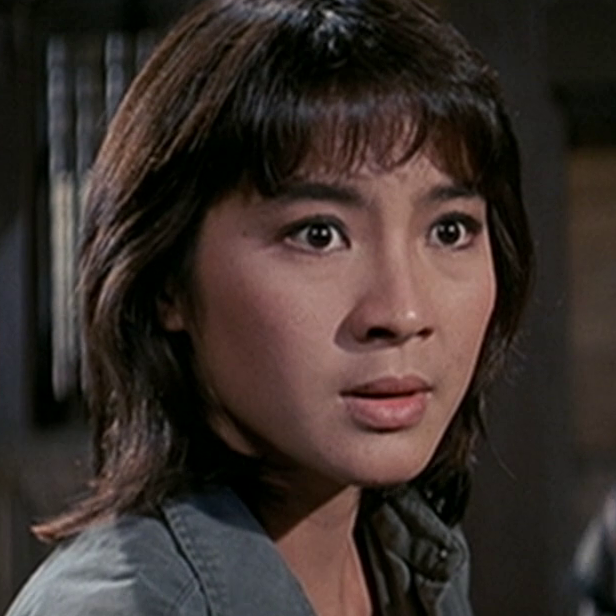
Her first starring role, Yes, Madam (aka In the Line of Duty), showcased her ballet skills when it came to her action scenes. Yeoh (billed as Michelle Khan) plays Inspector Ng, a Hong Kong detective who reluctantly teams up with Scotland Yard Detective Inspector Carrie Morris (Cynthia Rothrock, in her film debut) to solve a murder and stop a mob boss. Already, director Cory Yuen and Yeoh show off how her ballet moves make her fight scenes entertaining to watch. In the climax, when Ng and Morris take on the minions of the mob boss, Yeoh swings from a railing, does the splits, does a somersault in the air, and more as she fights them off. It’s thrilling to watch. The rest of the film doesn’t quite measure up, as Yuen isn’t able to make the humor and action work together (though producer/director Tsui Hark, in a rare acting role, is fun as a thief), and Yeoh’s acting skills aren’t quite up to her action skills, as she goes too over-the-top.
Her follow-up movie, Royal Warriors, has her Inspector Yip team up with a Japanese Interpol agent (Hiroyuki Sanada) and a Chinese sky marshal (Michael Wong) to foil a hijacking, only to find themselves targeted by the associates of the hijackers. Once again, Yeoh struggles somewhat with the dramatic scenes, especially when Inspector Yip becomes angry and motivated by revenge after a death. However, her fighting skills (which she’s described interviews as “Michelle style’) again are showcased well, using both swordplay (a wooden katana, though of course it’s not much use against real swords) and her fists and legs, especially in the bar fight scene.
Much better is the similarly-titled Magnificent Warriors. This movie sees Yeoh as Ming-Ming, an Indiana Jones-type spy, and daughter of a Chinese rebel, who teams up with another agent, a con man, a rebellious princess, and a local aristocrat to try and thwart the Japanese in 1930’s Tibet (or nearby). Again, the drama and comedy don’t quite work together, but Yeoh seems less awkward and more involved when it comes to acting. For instance, when she and the others attempt to flee the Japanese and are foiled when a soldier throws a stick of dynamite into their jeep, causing it to crash, she gives a look of calm resignation. And again, Yeoh acquits herself well in the fight scenes, even getting to use a machine gun at the beginning of the movie.

After marrying Dickson Poon, co-founder (with Sammo Hung) of D&B Films (which released Yes, Madam, among other films), Yeoh temporarily retired from acting, but when the couple divorced in 1992, director Stanley Tong, a friend of hers, reached out to her and suggested she get back into acting in a film he was directing. That film, Supercop (also known as Police Story 3), ended up teaming her with the most famous martial arts actor at the time, Jackie Chan. In this installment, Chan returns as Inspector Chan, a Hong Kong cop who is sent to mainland China to team up with Inspector Jessica Yang (Yeoh, billed again as Michelle Khan) to stop a drug kingpin. Tong doesn’t combine the humor and drama of the story the way Chan, as director, did in the first two Police Story movies, and once again, Maggie Cheung is wasted on the role of Chan’s jealous girlfriend. Still, Chan and Yeoh have an easy rhythm together, especially when Yeoh is pretending to be Chan’s sister and the two have to pretend to have a brother/sister squabble to maintain their cover. But, of course, the movie is best known for its action scenes, and they deliver. While Brigitte Lin had done some martial arts moves in a couple of scenes from the first Police Story movie, Chan in general at the time thought women didn’t belong in fight scenes, but Yeoh convinced him otherwise. Her most famous stunt, of course, is when Inspector Yang drives a motorcycle onto a moving train to help Chan catch the bad guys. She also has a terrific fight scene when she’s pretending to fight off Chinese army officers so Chan can get in good with the drug kingpin.
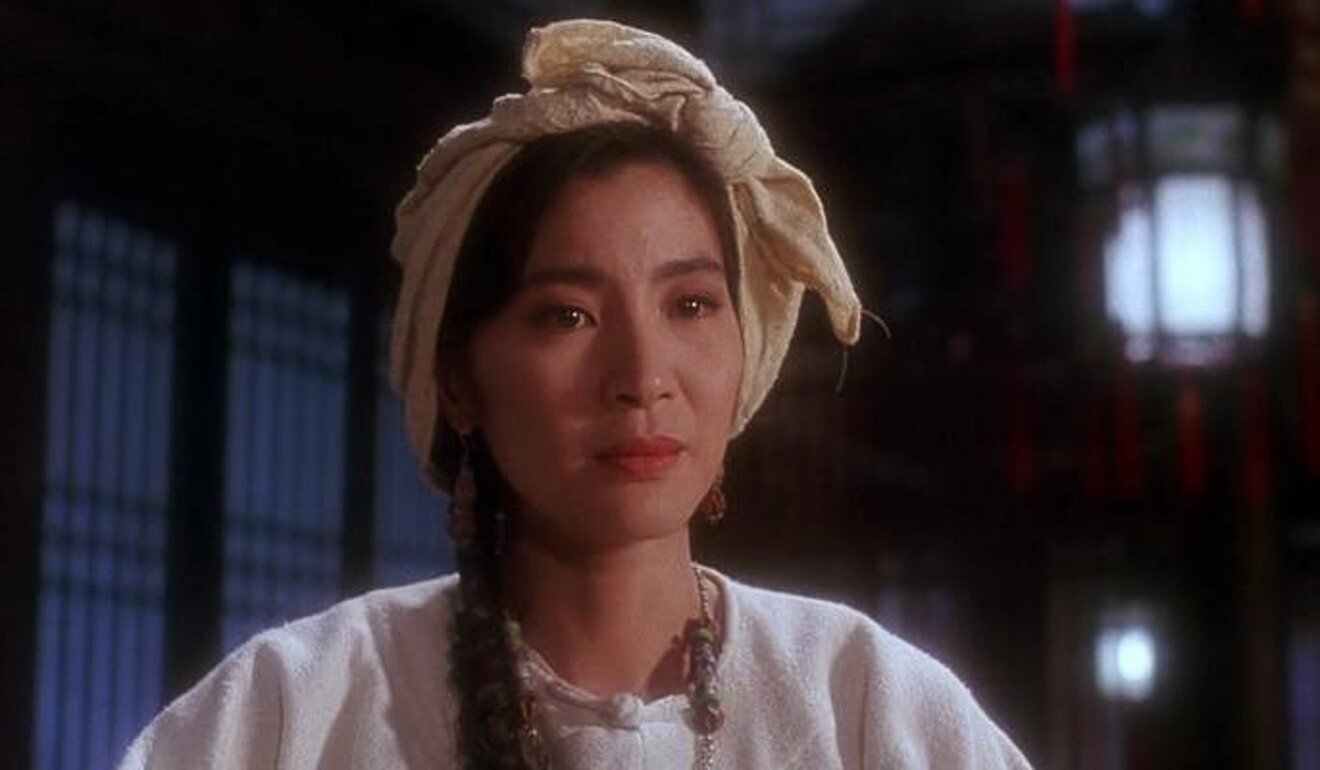
The following year, Yeoh appeared in a film with another famed martial artist from Hong Kong, Jet Li – Tai Chi Master, directed by Woo-Ping Yuen. The wuxia film, which Li also produced, isn’t as strong a vehicle for him as the first installments of Once Upon a Time in China or Fong Sai-Yuk, but it gives Yeoh her most dimensional role up to that point in her career. She plays Siu Lin, a woman who ends up teaming up with Li’s Zhang Junbao (thought to be the inventor of Tai Chi martial arts) with rebels against a tyrannical governor and against Junbao’s childhood friend Tienbo (Chin Siu Ho), who has become power-mad. Yeoh does hold her own in fighting (and unfortunately, as in Royal Warriors, is a Damsel in Distress at one point, though at least she’s able to get out of it on her own here), but she also gets more dramatic scenes to work with that show her coming into her own as an actress, as when she’s drowning her sorrows over the fact her husband has left her for another woman, or when she’s trying to help Junbao after he’s regressed mentally at the shock of Tienbo’s betrayal against him. She and Li don’t have the same type of relationship as she and Chan did in Supercop, but they also work together well.
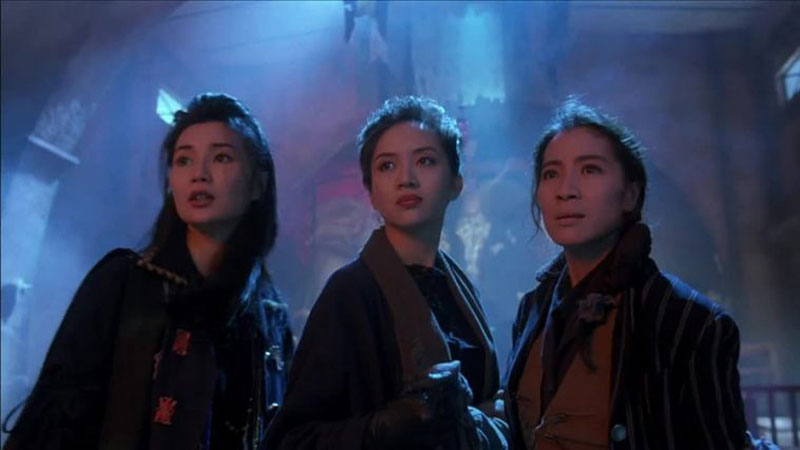
Yeoh’s best work in Hong Kong films for me, however, came in The Heroic Trio (which came out that year) and The Stunt Woman (which came out three years later). The former, a fantasy movie directed by Johnnie To, teams Yeoh with Cheung and Anita Mui (the late pop singer/actress) as the titular trio. Yeoh plays Ching, also known as Invisible Girl (no relation to Sue Storm from The Fantastic Four), who is working for an evil master (Shi-Kwan Yen) by kidnapping male babies so he can become the new Emperor of China. Ching is also working with an inventor (James Pax) she’s in love with who has been developing an invisibility cloak she uses to commit her crimes, while she’s being pursued by Tung (Mui), also known as Wonder Woman (not to be confused with that comic book character either), a superheroine whom she shares a past with (Cheung plays Chat, aka Thief Catcher, a mercenary who also shares a past with Ching). As with John Woo’s action movies, the plot can sound ridiculous on paper, but it’s the emotion the actors put into their roles, and the story, that makes the movie work. Watch, for example, the way Yeoh looks at Pax when she realizes he’s dying: even though the movie is chaste in portraying their romance, Yeoh clearly shows Ching’s feelings through her eyes and the expression on her face. That also shows in the scene where Ching and Tung recognize each other from when they were children. At the same time, Yeoh also triumphs in the action scenes, as when the evil master’s skeleton (the special effects are admittedly low-rent, but fun) takes over her body and forces her to fight Tung and Chat. Yeoh also works well with Cheung and Mui throughout the movie, including the fight scenes, but she stands out. The Executioners, its sequel, is set in the future, after a nuclear attack has helped make water scarce. Ching, now on the side of good, tries to protect the president (Shan Kwan) from a corrupt colonel (Paul Chun) and an evil demon (Anthony Wong, reprising his role from the first movie). Yeoh’s character arc isn’t as dramatic as of Cheung and Mui, but she’s able to play the most steadfast character here without making her dull, while again showing her prowess in the action scenes.

The Stunt Woman is a biopic directed by Ann Hui, and is also known as the movie that nearly got Yeoh killed during a stunt when she fractured her vertebrae doing a jump from a bridge onto a truck (according to Hui, when she visited Yeoh in the hospital, Yeoh said to her, “I’m sorry I ruined your shot”). Yeoh plays Ah Kam, the title character, who joins a stunt troupe who work for director Chief Tung (Sammo Hung, a comic actor who also worked as a director and stunt director). There are also subplots about a gangster who threatens the movie Kam and Tung work on, and how Kam becomes attracted to Sam (Jimmy Ga Lok Wong), a restaurant owner. Though Hui includes elementsfamiliar to martial arts movies (lots of fight scenes) as well as elements familiar to those who know about the Hong Kong movie industry of the 1980’s and 1990’s (e.g., there were triads involved in the making of many of those movies), this isn’t your typical martial arts movie. Hui and cinematographer Andy Lam use a lot of long takes and handheld camerawork during the fight scenes, as well as the more dramatic scenes, and they move the camera around and eschew the quick editing of Yeoh’s earlier movies. However, even though the movie itself doesn’t always work – the gangster subplot and the romance don’t always come together – Yeoh’s performance is still terrific. She’s more restrained here than she was in earlier performances, though she does show good chemistry with Wong, and as with Tai Chi Master and The Heroic Trio, she’s brought a subtlety to her acting.

Before Chan, Li, or Chow Yun-Fat crossed over into Hollywood films, Yeoh got there first. Unfortunately, her first movie in that department was not one of her best. As with all of the Pierce Brosnan Bond movies (except, to a certain extent, Goldeneye, the first one), I find Tomorrow Never Dies, directed by Roger Spottiswoode, to be mediocre. Spottiswoode, who has made movies I like (Under Fire and the made-for-HBO And the Band Played On), directs this in a plodding manner. The one-liners Bond has (Bruce Feirstein was credited with the script, though others worked on it) set my teeth on edge, not being funny at all (Brosnan would later say he didn’t enjoy making the movie, and it shows). And Terri Hatcher is bland as one of the “Bond Girls” (Hatcher apparently didn’t enjoy making the movie either). The pleasures of the movie come from Jonathan Pryce (clearly having a ball as Elliot Carver, the media mogul who’s the villain of the movie), Vincent Schiavelli (a lot of fun in his one scene as a professional assassin) and Yeoh. She plays Wai Lin, a Chinese secret agent who first poses undercover as a journalist (she claims to Carver she snuck into the launch of his new satellite network – which Bond ends up sabotaging – in order to meet him). Later, when Bond sneaks into one of Carver’s papers to find a device that was used to jam a British warship’s GPS signal, he discovers Lin has broken in as well, and while Spottiswoode and cinematographer Robert Elswit shoot Yeoh from too far away, she gets a nice moment when she waves goodbye to Bond as she sneaks out while walking up a wall. Later, in one of the movie’s big set pieces, Bond and Lin get captured by Carver’s men, only to escape while still handcuffed together, get on a motorcycle, and manage to destroy a helicopter that Carver sent after them. Later, when they’re taking an outdoor shower together (in arguably the sexiest scene in the movie), Lin uses one of her earrings to unlock herself from the cuffs and cuff Bond to the shower pipe. A little later, Yeoh finally gets to use her martial arts skills when she fights off a group of thugs sent by General Chang, the corrupt Chinese general who’s working with Carver. Unfortunately, the movie betrays her by making her a damsel in distress when she’s captured by Carver’s men, and Bond has to rescue her.
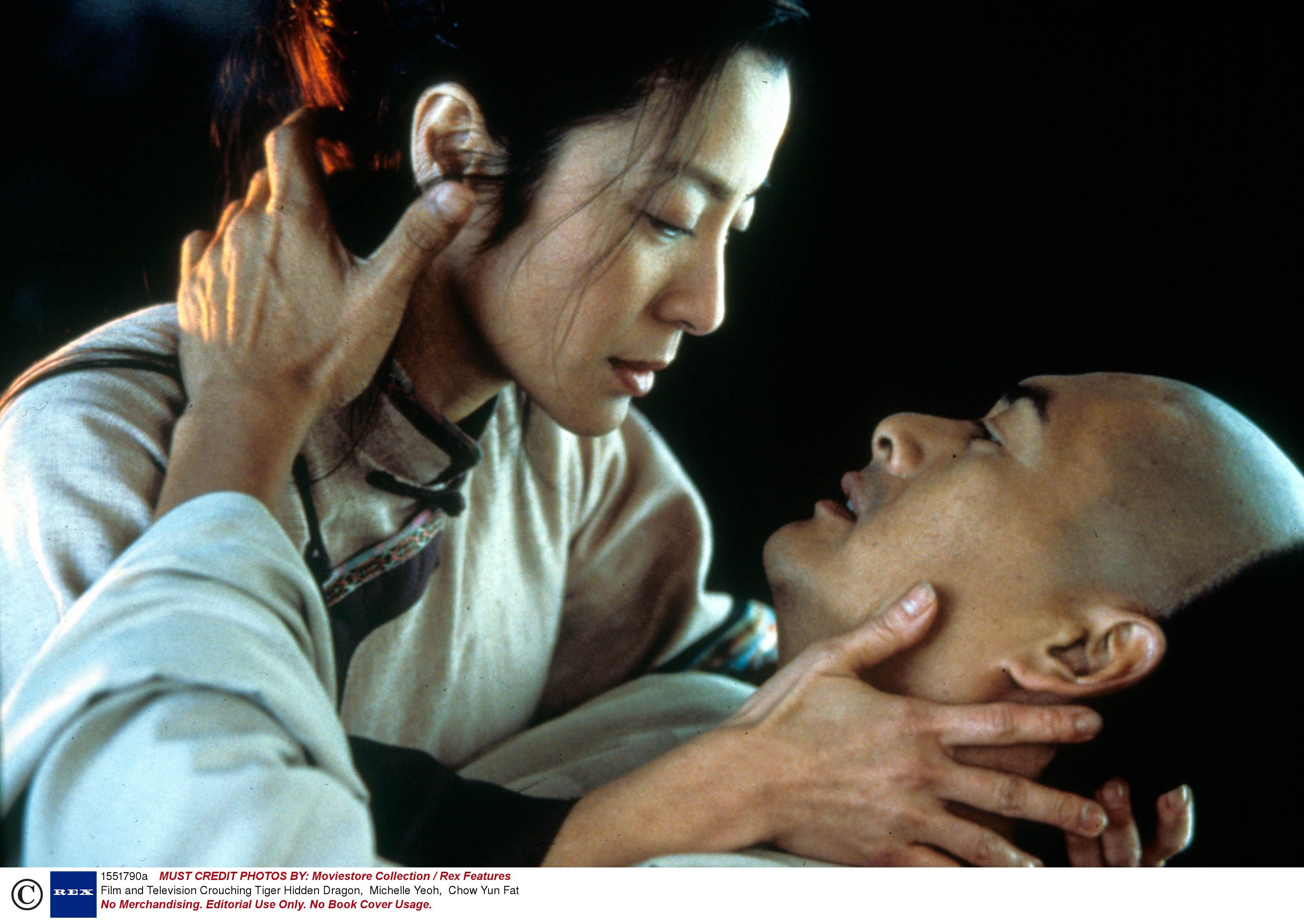
While Tomorrow Never Dies was a big hit, it was Crouching Tiger, Hidden Dragon that made Yeoh a star. Claude and I have already talked about this movie in a recent episode, but what’s worth bringing up again is how much the movie asks, and gets, of Yeoh. As with Hui, director Ang Lee (along with cinematographer Peter Pau) uses a lot of long takes for the fight scenes Shu Lien (Yeoh) has with Jen (Ziyi Zhang) both before and after Shu Lien discovers Jen is the thief, and stages them with great intensity. At the same time, Yeoh also has to play the repressed emotions between Shu Lien and Mu Bai (Chow Yun-Fat), and she does so with great subtlety, which makes the scene where they finally confess their feelings for each other – as Mu Bai is dying – all the more heartbreaking.

Better, though still flawed, was Reign of Assassins, co-directed by John Woo. In this period action movie set during the Ming dynasty, Yeoh plays Drizzle, a thief and assassin who was part of a group of deadly assassins known as The Dark Stone, until she decides to give up that life, change her appearance (Kelly Lin plays Drizzle before the change), becomes a shopkeeper (under the name Zeng Jing), and falls in love with Ah-Sheng (Jung Woo-Sung), a messenger, until her past catches up to her. The plot is somewhat confusing, though Yeoh and Woo-Sung’s chemistry and Woo’s able direction help keep you interested. Still, the best genre movie Yeoh did during this time was Fearless, and only in the director’s cut (the movie was directed by Ronny Yu), where she played the mother of Huo Yuanjia (Jet Li again).
Yeoh also turned towards more prestige projects as well, though again, it was with mixed success. Memoirs of a Geisha, Rob Marshall’s adaptation of Arthur Golden’s best-selling novel, was criticized at the time for casting non-Japanese actors (mostly Chinese, though Yeoh of course is Malaysian) as Japanese, but it’s also tonally all over the place, and is often ridiculous instead of involving. Still, Zhang (as the title character), Yeoh (as her mentor), and Gong Li (as Zhang’s rival) acquit themselves well with their performances, though in different ways (Yeoh and Zhang are dignified throughout, while Li channels Bette Davis and is all the more entertaining for it).

Sunshine, which reteamed director Danny Boyle and writer Alex Garland, was a science fiction movie which saw Yeoh as part of an ensemble cast (including Rose Byrne, Cliff Curtis, Chris Evans, Cillian Murphy and Benedict Wong) playing a group of astronauts taking the Icarus II towards the sun to try and revive it. I’m one of those people who think the movie is better in the first half (when it’s aping Kubrick’s 2001) than in the second half (when it turns into Event Horizon). Still, Yeoh manages to shine among the rest of the cast. On the one hand, Corazon, the biologist on the ship, is portrayed as the one most coldly logical, especially when she argues the rest of the crew should kill someone who’s put them all in jeopardy. On the other hand, Corazon is devoted to the plants in the oxygen garden on the ship, and she’s devastated when the plants die thanks to a mishap, as well as wondrous when she sees the oxygen garden on another ship the crew comes across, and Yeoh plays all of that well.
The Children of Huang Shi reteamed her with director Roger Spottiswoode and actor Chow Yun-Fat (though the two don’t share any scenes together) in this docudrama about George Hogg (Jonathan Rhys-Meyers). Hogg was a British journalist who helped save 60 Chinese orphans from the Japanese in the 1930’s by taking them to the Mongolia desert, with the help of Chen (Yun-Fat), a Chinese communist soldier, and Lee (Radha Mitchell), a nurse and aid worker. This is yet another movie about people of color with a white person as the protagonist, and it doesn’t help Myers (whom I’m admittedly not a fan of) is bland as Hogg. That said, the movie doesn’t downplay the horrors of what the Japanese did to the Chinese then, and Yun-Fat and Mitchell are good, as is Yeoh as a black-market dealer who helps Hogg and develops feelings for him.
The Lady, directed by Luc Besson, is another docudrama, with Yeoh playing the main role this time as Aung San Suu Kiyi, the Burmese political leader put under house arrest in the 1990’s when the military refused to accept the fact she had won the election or the democratic reforms she pursued. There’s too much clunky dialogue, and Besson spends more time with David Thewlis, as Kiyi’s husband (who fought to bring international pressure to gain her release) than with Kiyi. Nevertheless, Yeoh again projects strength and dignity in the role, and convinces you of her love for Thewlis.
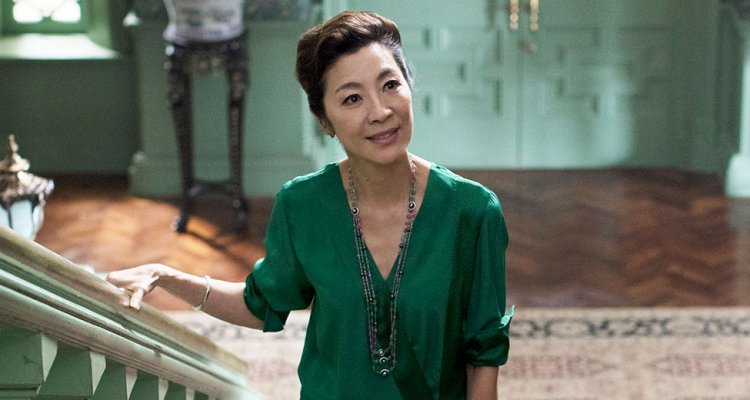
Still, it wasn’t until Crazy Rich Asians, directed by Jon M. Chu (adapted from the first in a series of novels by Kevin Kwan) that Yeoh finally found a role worthy of her talents, as well as being the first English-language movie since The Joy Luck Club with an all Asian (or Asian-American) cast (and like The Joy Luck Club, it did well at the box office). The movie does suffer from some of the problems that bedeviled romantic comedies since the 1990’s; there’s too much on-the-nose dialogue, it takes the ostentatiousness of wealth display up to eleven, and the bachelorette party is off-putting in how it portrays all women as being shallow. What makes the movie work is Chu gets us to root for the main couple, Rachel (Constance Wu), an NYU economics and game theory professor, and Nick (Henry Golding), a history professor and her secretly rich boyfriend, to get together. Chu surrounds them with strong supporting performances, including Awkwafina as Rachel’s best friend Peik Lin, Gemma Chan as Nick’s cousin Astrid, Lisa Lu as Nick’s grandmother Su Yi, Nico Santos as Nick’s cousin Oliver, and Tan Kheng Hua as Rachel’s mother. Still, it’s Yeoh, as Nick’s disapproving mother Eleanor, who stands out in the movie. Yeoh is involved in two of the (justly) memorable scenes of the movie, both featuring Eleanor and Rachel. The first is when Eleanor confronts Rachel on the stairs, telling her how Su Li disapproved of Nick’s father before he married Eleanor, and she coldly tells Rachel, “You will never be enough.” The second is the Mahjong game, when Rachel tells Eleanor Nick proposed to her (after Nick had sworn to cut himself off from his family when he found out Su Yi had dug up dirt on Rachel’s family, with Eleanor’s approval) but she turned him down because she didn’t want Nick to lose his mother. In both scenes, Yeoh subtly communicates a range of emotions – with the first, while it sounds at first like Eleanor’s telling Rachel to stay away from Nick, it can also be implied Eleanor doesn’t want Rachel to go through what she had to go through, and with the second, Eleanor gets a slight catch in her voice when she tells Rachel how foolish it was for her to throw away a winning hand. Yeoh’s not the only reason those two scenes work, of course – Wu matches up with her equally, and Hua has a great moment in the second scene when she glares at Eleanor after Rachel leaves the game – but she’s the prime reason. And Yeoh is good throughout the rest of the movie as well, from the opening scene when a racist hotel manager won’t let her and her children in to the look of disapproval that flashes across her face when Rachel hugs her at their first meeting. When you think of the caricatures of mother-in-law characters in American romantic comedies (I still cringe thinking of Jane Fonda in Monster-In-Law), Yeoh’s performance stands out all the more.

Many fans thought Yeoh deserved an Oscar nomination for that performance, but one finally came her way with Everything Everywhere All at Once. I’m in the group that likes, rather than loves, the movie – unlike many, I find the hot dog fingers scene annoying rather than funny or entertaining, and it sometimes seems like the Daniels (Kwan and Scheinert, who co-wrote and co-directed the movie) are more interested in getting off on the multiple universes Evelyn (Yeoh) is entering than in telling the story. Still, it is very much worth watching because the emotional core of the movie – Evelyn learning to reconnect with her husband Waymond (Ke Huy Quan) and especially her daughter Joy (Stephanie Hsu) – is always kept front and center, and Yeoh’s performance is a big reason why. The Daniels admitted they originally thought of having Jackie Chan in the lead until they realized the story would work better with a woman at the center, and wrote the movie specifically for Yeoh (who also served as an executive producer). Of course, it helps if you know Yeoh’s filmography (and in the universe where Evelyn is a movie star, the scenes of her at movie premieres and awards ceremonies are all real-life footage of Yeoh), but even if you’re only dimly aware of it, Yeoh’s performance works. She’s more over-the-top here than in most of her performances, especially when Evelyn doesn’t know what to make of what Waymond is telling her about the alternate universes, or when she butchers the title of Ratatouille when trying to explain to her family what’s going on. Still, Yeoh gets to kick ass once again in some fight scenes, and again, she does subtle work in much of the movie, especially when Evelyn rights herself after going through a period of self-doubt, and when she finally reconnects with Joy.
Where Yeoh goes after this in her career remains to be seen. For the past couple of years, it seems as if she’s mostly been playing supporting roles, often as mentors to the main character (the one movie in that vein that I’ve seen, Gunpowder Milkshake, is yet another movie where Yeoh is better than the script she’s doing, though she does get some good fight scenes and works well with Carla Gugino, who, it’s implied, plays her lover). In her nearly 40 year career, however, Yeoh has shown herself capable of handling almost any role handed to her, and I for one can’t wait to see what she does in the future. In addition, while I haven’t seen enough movies or performances to definitively judge the Best Actress category at the Oscars, I will be happy if she wins.