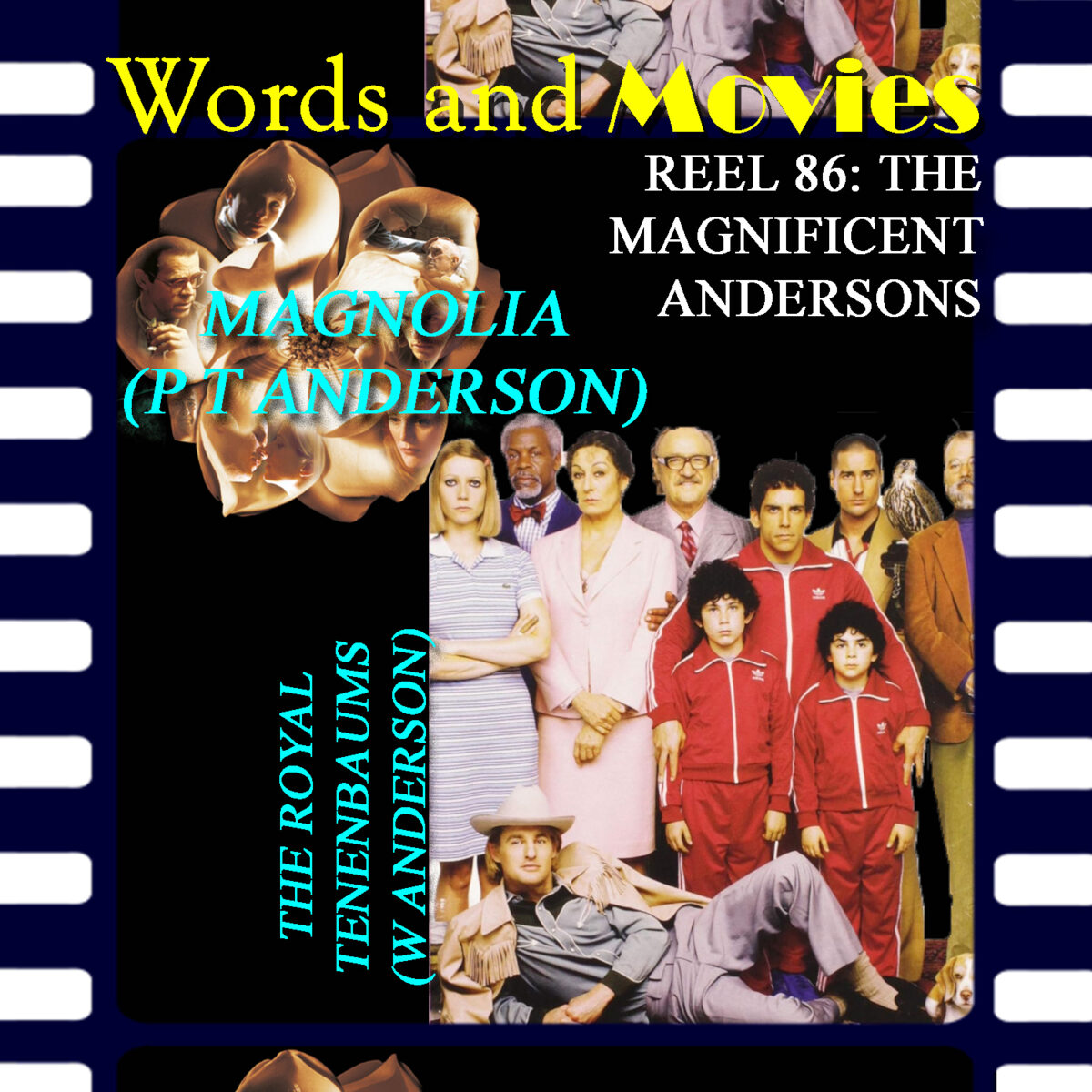
Reel 86: The Magnificent Andersons

And this, children, is what happens when you don’t hit the “Publish” button. Enormous apologies and thanks for your patience. I’ll make up for it by publishing another episode tonight, since that was the plan anyway.

While I’m at it, I also apologize for the cover art. I couldn’t come up with anything good.

This episode looks at a pair of films by two (unrelated) directors whose last name is Anderson.

We open up with MAGNOLIA (1999), directed by Paul Thomas Anderson. This is a story that doesn’t so much have a plot as it has several plots, each bumping into one another from time to time (think of Altman’s SHORT CUTS, which we talked about back in Episode 34). It’s a fun ride, even if you sit there wondering what one thing has to do with the other. And the answer is: sometimes, not much. But P.T. Anderson sets you up for that early in the film, so you have nothing to complain about. And it’s a long film, so we have a lot to talk about, so don’t complain about that either.

In Part Two we move on to Wes Anderson and his 2001 film THE ROYAL TENENBAUMS, starring Gene Hackman (RIP), Anjelica Huston and a small company of actors as their children and other relatives. The family is in bad shape, until a lie brings them all together. Then it splits them up. Then…well, we presume that if you’re reading this you already knows what happens. But if you haven’t, what are you waiting for? Go see it! Come back and let us know what you thought!


COMING ATTRACTIONS:

In Episode 87 we’re keeping our focus (heh) on directors, with two films that are semi-autobiographical in nature. We’ll begin with MEAN STREETS (1973), directed by Martin Scorsese, and finish with DINER (1982), directed by Barry Levenson. Join us, won’t you? 


R.I.P., Gene Hackman

Ever since the movies became a business in the U.S. (which started way back in the silent era), the men behind them sold an image not only of the U.S., but of glamour and beauty, which extended to the people that appeared on-screen. Many of the best movies ever made in Hollywood then (and even now), to be sure, featured glamorous-looking men and women doing glamorous things. Yet at the same time, during the studio era, there was also room for character actors (men and women) who could work with those glamorous men and women and hold their own with them. As the studio era ended in the 1960’s, there were more and more movies being made by people who, instead of casting the glamorous-looking men and women in leading roles, cast people who looked like the character actors in leading roles (regrettably, this was mostly white men), and some of those who looked like character actors could hold the screen like those leading men and women of the studio era. One of the best in that category was Gene Hackman, who died February 26 of this year at the age of 95.

Hackman had said he knew he wanted to be an actor ever since he was 10 and had become a fan of movies, particularly ones with James Cagney and Errol Flynn, his favorite actors, though it took him a while to get there. A couple of years after his parents divorced (his father left them), he joined the Marines (after lying about his age), serving for four and a half years (after WWII) in China, Hawaii, and Japan. After working in various jobs in New York, he attended the University of Illinois on the G.I. Bill, where he studied journalism and TV production before dropping out and moving to Los Angeles. There, he got involved in theater at the Pasadena Playhouse and met Dustin Hoffman, who remained a close friend for the rest of his life. Hackman and Hoffman often mentioned they were both voted “Least Likely to Succeed” by their classmates, he worked odd jobs when he couldn’t get acting gigs, and for the next several years, he got guest roles on such TV shows as The Defenders and Naked City and bit roles in movies such as Lilith and Hawaii. It was his bit part in the former, however, that would eventually change Hackman’s life.

As Buck Barrow with his brother Clyde (Warren Beatty) in Bonnie & Clyde.

Though Lilith was not a big hit, Warren Beatty, who was the star, remembered and liked working with Hackman, so when he was finally able to get Bonnie & Clyde made, Beatty convinced director Arthur Penn to cast Hackman as Clyde Barrow’s brother Buck (in one of those tantalizing what-could-have-been twists, Hackman was also originally cast as Mr. Robinson in The Graduate, which would have put him opposite Hoffman, but director Mike Nichols fired him about three weeks into rehearsal for being too young). Claude and I have already talked about Bonnie & Clyde, and while Hackman’s not the best reason to see the movie, he brings a bolt of energy to it whenever he’s on-screen, from when Buck first appears while reuniting with Clyde all the way until his death scene. The movie also shows one of Hackman’s most distinctive traits, his laugh, which is hearty in this performance, but would later become a chuckle that Hackman could make inviting or threatening. Beatty and Faye Dunaway (Bonnie) may have emerged as the stars of the movie, but Hackman proved he could hold his own with them.

As Eugene Claire, coach to David Chappellet (Robert Redford), in Downhill Racer.

Being older than Hoffman (as well as their mutual friend Robert Duvall, whom they both lived with for a time when all three were struggling actors), Hackman was already being cast in authority figures. One of the best of these was as the ski coach in Downhill Racer, Michael Ritchie’s terrific drama about downhill skiing. As Eugene Claire (Eugene was Hackman’s real first name), coach to the title character, David Chappellet (Robert Redford), Hackman was playing what at first seemed to be the stock role of the coach who tries to teach the maverick athlete to be a team player. It’s what Hackman does with the role that makes it interesting. As you might expect from this type of movie (though it’s not an “inspirational” sports movie, as Chappellet is a jerk who never gets redeemed at the end), Claire has a few speeches (“No one races unless I say so. That’s why I’m here. That’s why they made me the coach”), but what makes them work is Hackman never feels he has to prove his authority. He just delivers the speeches without any bull, whether talking with Chappellet, the other skiers on the team, or making his pitch to sponsors. When writing about Uncommon Valor, one of those “we-could-have-won-in-Vietnam-if-it-wasn’t-for-the-goddamn-liberals” movies that was so popular during the Reagan era,  Pauline Kael wrote Hackman “offers a range of held-in, adult emotion that you don’t expect”, and that could also describe his performance here.

As Popeye Doyle in The French Connection.

Though Hackman would also show he was capable of playing a less flamboyant role with his performance in Gilbert Cates’ I Never Sang for my Father (a stagy but compelling adaptation of the play by Robert Anderson, with strong performances by Hackman – possibly channeling his feelings towards his own father – Melvin Douglas, and Estelle Parsons, doing better here, in my opinion, than when she had played Hackman’s wife in Bonnie & Clyde), it was playing another authority figure that finally made him a star. A lot has been written about Hackman’s turn in William Friedkin’s The French Connection, including how Friedkin had been turned down several times when trying to cast the role of maverick detective Popeye Doyle, how Hackman took the role because he thought it would let him emulate Cagney, and how he quickly became uncomfortable with the violence of Popeye’s world. Still, no matter what you think of the film – though I’m far from being a fan of Friedkin, I do agree this is one of his best films, even if, like other movies of the time, its casual acceptance of the drug war as a good thing doesn’t age well for me – Hackman’s performance as Popeye remains one of the best of his career. You can see the charge Hackman brings to the role, such as when Popeye’s confusing a suspect by saying he’s going to nail him “for picking your feet in Poughkeepsie”, or, during the famous car chase scene, how he reacts when he’s trying to avoid pedestrians on the road, or when he’s playing cat-and-mouse with Charnier (Fernando Rey), the main bad guy, at the subway station. But while Popeye the character may have been brutal, again, Hackman made him seem real instead of just another macho action hero.

As Max in Scarecrow.

While I’m afraid I’m not a fan of Hackman’s turn as the minister who sacrifices himself to save other passengers in the disaster movie The Poseidon Adventure (Hackman himself would admit it was a “money job”), the next few years brought some of his best performances. He reunited with Ritchie for Prime Cut, a bizarre but compelling crime drama where he played Mary Ann, a crooked meatpacker who crosses paths with mob enforcer Devlin (Lee Marvin), and his go-for-broke performance not only fits with the tone of the film, but matches well against Marvin’s quiet but powerful one. Hackman also worked well as a crooked cop blackmailing singer and former drug dealer Kris Kristofferson into dealing again in Bill L. Norton’s underrated Cisco Pike. And he showed he could also be funny in a scene-stealing cameo as the blind hermit in Mel Brooks’ loving parody of Universal Horror films, Young Frankenstein. However, it was three other films Hackman did during this period – Jerry Schatzberg’s Scarecrow in 1973,  Francis Ford Coppola’s The Conversation in 1974, and Arthur Penn’s Night Moves in 1975 – that represented the peak of his career.

As Harry Caul in The Conversation.

In the first, Hackman plays Max, an ex-con who’s trying to hitchhike to Pittsburgh to set up a car wash business, and ends up with Francis (Al Pacino), a former sailor trying to get to Detroit to see his son. As with many of his roles at the time, Hackman is playing big, whether he’s pausing before getting up from the kitchen table until he belches, or fighting with the same convict (Jerry Reed) who beat up Francis, or dancing in a bar to the tune of the song “The Stripper”, but again, it all seems natural rather than showing off, and it’s balanced against more quiet moments, as when he reacts to Francis having a nervous breakdown at the end. By contrast, in the second, Hackman plays Harry Caul, a surveillance expert who tries his best not to get involved with anything except his work, and who tries not to give anything away about his life until he gets involved in the case involving the couple (Frederic Forrest and Cindy Williams) he’s investigating. Most of Hackman’s performances, before and afterwards, depended on his physicality, but as Harry, Hackman is incredibly still, both with his facial expressions and the way he holds himself together, especially when being challenged or threatened (especially by one of his employers, played by Harrison Ford, or a rival surveillance expert played by Allan Garfield). The only thing that gives Harry any spark in his life is his love of jazz, whether he’s listening to it or playing along on his saxophone, and you see that spark in him, even at the end, when Hackman’s playing the sax in resigned acceptance of his fate. Finally, in the third, Hackman plays Harry Moseby, an ex-football player turned private eye who’s hired to find the missing daughter (Melanie Griffith) of an ex-actress (Janet Ward) and finds himself mixed up in murder and smuggling. Penn’s film is just now getting remembered as one of the best of the revisionist private eye movies of the 1970’s, and Hackman not only brings out the physicality of the role (as when he tangles with a young James Woods as Griffith’s friend), but also makes it believable Moseby is in over his head in every way.

As Harry Moseby in Night Moves.

Though all three movies were well-reviewed (and Hackman would consider the first two his favorite performances), none of them did well at the box office (though all three have gained in reputation over the years), which not only left Hackman depressed, but led him to take more of what he called “money jobs.” He turned down roles in such films as One Flew Over the Cuckoo’s Nest, Close Encounters of the Third Kind and Ordinary People (the one movie he regretted turning down) to star in movies such as Lucky Lady (directed by Stanley Donen), The Domino Principle (directed by Stanley Kramer), and March or Die (directed by Dick Richards), all considered career nadirs (Zandy’s Bride, which teamed him with director Jan Troell and actress Liv Ullmann, was a misfire, but not a money job – I haven’t seen Richard Brooks’ western Bite the Bullet, but Hackman thought a scene he did with Candace Bergen represented the best acting of his career, and Roger Ebert praised it). The first two Superman movies (shot simultaneously, though Richard Lester reshot much of the second one over Hackman’s objections) were also movies Hackman considered money jobs, and led him to retire from acting temporarily. In addition, I must confess I’ve never been a fan of Hackman’s conception of Lex Luthor as a comic villain (Clancy Brown’s voice performance of Luthor in Superman: The Animated Series and the two Justice League series’ that followed remains my favorite incarnation of the character). Still, there’s no denying Hackman does play the comedy well, from the chuckle he gives when Miss Tessmacher (Valerie Perrine) insults him, or the way he underplays his reaction when he sees Otis (Ned Beatty), his bumbling sidekick, has made a claim to part of his territory, or, in the second movie, when he double-crosses Superman (Christopher Reeve) and then, when it turns out Superman was counting on that in order to defeat Zod (Terrence Stamp), pretends it was all part of his plan.

As Lex Luthor in Superman II.

Hackman was lured back to acting in 1981 with two roles. In the romantic comedy All Night Long, directed by Jean-Claude Tramont, he plays the night manager of a drugstore who becomes involved with the lonely wife (Barbra Streisand) of a firefighter. While the movie has its fans (including Kael), I confess it doesn’t quite work for me, though you can tell Hackman was invested in the material. Hackman then reunited with Beatty for Reds, his flawed but compelling look at the Communist revolution in the early years of the Soviet Union, and brings a charge to his scenes with Beatty as a former editor to John Reed (author of Ten Days That Shook the World). After that, with the exception of Under Fire and No Way Out (1987)both of which Claude and I talked about – Hackman’s output in the rest of the decade, like other actors who broke through during the “New Hollywood” movement of the 1970’s, didn’t live up to his ability. I must admit it’s not entirely fair to lump Nicholas Roeg’s Eureka into that category, given it was taken away from him in the editing room, but while Hackman is good in the movie as usual, it’s a mess. I know there are fans of David Anspaugh’s Hoosiers, but I’m not one of them, though as with Uncommon Valor, Hackman’s underplaying makes his performances work, even if the movies don’t work for me. While in Bud Yorkin’s Twice in a Lifetime, Hackman played a part mirroring his own life – his character leaves his wife (Ellen Burstyn) for another woman (Ann-Margaret), though in real life, Hackman had gotten divorced before finding another woman – the movie is a paper-thin exploration of that. While Woody Allen’s Another Woman is the best of his Bergman homages, it only works thanks to the performances of such actors as Gena Rowlands (in the lead), Ian Holm (as her cold husband), and Hackman (as his best friend and the one she realizes she really loves). And Power (Sidney Lumet’s big business drama), Target (a spy thriller that reunited him with Penn), and Full Moon in Blue Water (a rare comedy that reunited him with his The Conversation co-star Teri Garr) were missed opportunities.

AS Anderson (with Brad Dourif as Deputy Sheriff Pell) in Mississippi Burning.

One of the ironies of Hackman’s career is while in real life he abhorred violence (he was a registered Democrat, though he admitted to admiring Ronald Reagan), most of his most famous roles involved his character committing violent acts. That was also true of the movie that earned him his fourth Oscar nomination (after Bonnie & Clyde, I Never Sang for my Father, and The French Connection, which earned him his first win, for Best Actor),  Alan Parker’s Mississippi Burning. I confess this is another film I’ve never been a fan of, as I feel it’s yet another movie about civil rights told from the point of view of whites and that diminishes African-Americans, it’s insulting in how it makes the FBI the heroes, given how much director J. Edgar Hoover loathed civil rights leaders, and with the exception of R. Lee Ermey’s mayor character, all the villains are portrayed as one-dimensional cartoons (though Brad Dourif, as usual, does a lot with a little). Given all that, I will admit the one good thing the movie does is its portrayal of the relationship between Hackman (as Anderson, a former southern sheriff turned FBI agent) and Frances McDormand (as the lonely wife of Dourif’s deputy sheriff Pell). Hackman believes McDormand knows something about the murder of three civil rights workers, so he talks to her at the beauty parlor she goes to, or her home, and Hackman shows his feelings for her again without overplaying (Parker, who rewrote Chris Gerolmo’s screenplay, had added a sex scene between the characters, but Hackman wisely talked him out of it). As for that violence, one of the most memorable scenes in the movie is when Anderson takes revenge on Pell for brutally beating his wife while in the barbershop, and while Parker overdoes the scene in shooting it, Hackman is utterly convincing the way he turns on a dime from being cheerful to intimidating and then violent.

As Sheriff Little Bill Daggett in Unforgiven.

It was the reception to that scene – being the scene shown by the studio when promoting Hackman’s performance for the Oscars – that led Hackman to turn down directing an adaptation of Thomas Harris’ The Silence of the Lambs after he initially agreed to do it. It also led him to initially turn down Clint Eastwood’s offer to play Little Bill, the sheriff who runs his town with a iron fist, in Unforgiven (before that, Hackman appeared in three good, if not great, movies – The Package, Andrew Davis’ Cold War thriller where Hackman is pitted against Tommy Lee Jones, Postcards from the Edge, Mike Nichols’ adaptation of Carrie Fisher’s semi-autobiographical novel, where Hackman lends a charge to his two scenes as a film director, and Class Action, a rare case where Hackman played a character close to his political views (a crusading lawyer), and where he and Mary Elizabeth Mastrantonio, as his estranged daughter, made what could be routine material work). But when Eastwood, who had also made his name with violent movies (the Man with No Name trilogy and the Dirty Harry movies), convinced Hackman the movie – about Will (Eastwood), a reformed killer brought out of retirement to claim a bounty a group of prostitutes have taken on a cowboy who roughed one of them up – would be interrogating that violence, Hackman signed on, earning his second Oscar (for Best Supporting Actor) in the process. Little Bill doesn’t tolerate vigilantism in his town, but what makes Hackman’s performance resonate is the lengths he’ll go to stop that violence, from the way he humiliates English Bob (Richard Harris), a gunfighter whose reputation outstrips his abilities, or the way he beats Ned (Morgan Freeman), Will’s friend, or the way he humiliates Will. While I still think Jaye Davidson should have won that year (and don’t love Unforgiven the way others do), Hackman’s performance is one of his best.

As John Herod in The Quick and the Dead.

Hackman followed that with another great performance in Sydney Pollack’s The Firm, the first adaptation of one of John Grisham’s novels. In my obituary for Robert Towne (one of the screenwriters of the movie), I raved about the writing of Hackman’s last two scenes in the movie – he plays Avery Tolar, a crooked lawyer who serves as mentor to new lawyer Mitch (Tom Cruise) – but those scenes he has with Jeanne Tripplehorn (as Abby, Mitch’s wife) show acting as good as anything he did in Unforgiven. After that came three westerns – Walter Hill’s Geronimo: An American Legend, Lawrence Kasdan’s Wyatt Earp, and Sam Raimi’s The Quick and the Dead. Of the three, only Raimi’s movie holds up for me – unfairly dismissed at the time, it’s an enjoyable American attempt at a spaghetti western. And while John Herod, the evil leader of the western town, is a more cartoonish role than Little Bill, Hackman is able to be comic and dangerous at the same time, whether he’s taking on a fraud gunfighter (Lance Henriksen), a real one (Keith David), or expressing his anger with the townspeople. Hackman’s best scenes however, come with Russell Crowe (as Cort, a former member of Herod’s gang until he reformed to become a preacher), Leonardo DiCaprio (as The Kid, who claims to be Herod’s biological son, which Herod denies), and star and producer Sharon Stone (as the unnamed main character, who has a grudge against Herod). For Crowe, it’s when Herod admits he’s always wanted to duel against Cort in a gunfight – there’s a sexual tension Hackman brings to the scene that makes it all the more disturbing. In contrast, with DiCaprio, it’s when Herod tries to talk the Kid out of dueling with him, as well as the genuine look of regret on his face at the end of the duel. Finally, with Stone, it’s when Herod invites Lady to his house for dinner and tells her about his father, and the gleam in his eye that shows what a psychopath he really is.

As Harry Zimm in Get Shorty.

After the three westerns came yet another movie other people like more than me, Tony Scott’s Crimson Tide, though as a submarine commander, Hackman does work well with Denzel Washington, who plays his second-in-command. Hackman then shifted again to comedy for his next two roles. In Get Shorty, Barry Sonnenfeld’s adaptation of the Elmore Leonard novel, Hackman plays Harry Zimm, a B-movie producer who gets mixed up with Chili Palmer (John Travolta), a loan shark who comes to collect money from Zimm but who really wants to produce movies. Hackman’s not the funniest actor in the movie – Danny DeVito, as an egotistical movie actor inspired by Dustin Hoffman, is – but he’s not afraid to look foolish and weak, especially when he thinks he’s putting one over on mobster Ray “Bones” Barboni (Dennis Farina), only to find out just how wrong he is. For all the toughness Hackman often showed in his performances, his willingness to show his characters’ weak sides was one of the best sides of his talent. For many people, that also came out in his next comedy, The Birdcage, an English-language version of the French play La Cage aux Folles (filmed in France in 1978), where Hackman plays Kevin Keeley, a conservative  senator unaware his daughter (Calista Flockhart) is engaged to be married to the son (Daniel Futterman) of a gay couple (Robin Williams and Nathan Lane). This is another movie I don’t like as much as others – I feel the laughs it goes for are easy (to be sure, I also think that of the French film) – but while Hackman’s character may seem at first to be one of those easy laughs at first (of course, he praises the Moral Majority and Pat Buchanan, and then has to escape the press by dressing in drag), Hackman again makes his character seem real instead of a caricature.

As Brill in Enemy of the State.

With the exception of his only foray into animation, voicing the villain in Antz, Hackman next turned to mostly thrillers (including Extreme Measures, which reunited him with Apted, Absolute Power, which reunited him with Eastwood, and Twilight – not the vampire movie, but a neo-noir directed by Robert Benton and co-starring Paul Newman and Susan Sarandon), the best of which was his second and final movie with Scott, Enemy of the State (which Claude and I already talked about). Though it’s a more high-octane version of The Conversation, I think Enemy of the State is both entertaining and thought-provoking, and though he doesn’t show up until almost halfway through the movie, Hackman is a big reason why, being convincing not just in the jargon he has to speak (when his character, Brill, is describing to lawyer Robert Dean (Will Smith) the technology the NSA is using) or the more physical aspects of the role (when he punches out Dean at one point).

As Royal in The Royal Tenenbaums.

Another one of the paradoxes of Hackman’s career is he was one of most prolific actors of his lifetime while also often expressing a desire to quit. *
2001 was the last time he appeared in more than one film that came out, in fact appearing in five – Gore Verbinski’s The Mexican (though that was a cameo), David Mirkin’s Heartbreakers (another comic turn), David Mamet’s Heist, John Moore’s Behind Enemy Lines (a reversal from a Hackman movie I never saw, Bat *21, where in this case, he was the military officer trying to arrange the rescue of another downed officer), and best of all (as far as I’m concerned, though I liked Hackman in Heist), Wes Anderson’s The Royal Tenenbaums. Hackman and Anderson apparently quarreled throughout filmmaking (Hackman would later admit he was bothered by the age difference between them, as well as the fact Anderson wrote Hackman’s part with Hackman in mind), but in playing Royal Tenenbaum, the down on his luck patriarch of a dysfunctional family who pretends he’s dying so he can get his family back, Hackman showed a joy in his scenes that’s infectious, especially in the scenes with his two grandsons (sons of his own estranged son Chas (Ben Stiller), while again not afraid to look foolish, especially in a lunch scene with his adopted daughter Margot (Gwyneth Paltrow), where he reveals how little he knows about her by claiming she doesn’t have a middle name, only to be proven wrong.

As Rankin Fitch (with Marguerite Moreau as Amanda Monroe) in Runaway Jury.

If Hackman had decided to retire after this movie, many of his fans (myself included) would have felt he was ending his career on a high note. However, that was not to be. His next movie was his third and final Grisham adaptation, Runaway Jury, which also marked the only time he and Hoffman ever appeared on-screen together, though they opposed each other in the film (Hoffman played Wendell Rohr, a lawyer who’s filed suit against a gun company on behalf of the widow of one of the victims, while Hackman played Rankin Fitch, a crooked jury consultant working on behalf of the gun company being sued). However, along with the fact this was yet another movie whose intentions were better than its execution, the one scene Hackman and Hoffman appear in together – a confrontation in the courthouse bathroom – came off as obvious and ham-handed (the one time Hackman and Duvall ever appeared on-screen together, in Geronimo: An American Legend, it was similarly underwhelming, though in that case, it was because it felt flat and uninspired). Welcome to Mooseport, which teamed him with Ray Romano, was his final film, and a comedy, but one that also fell flat. As with The Royal Tenenbaums, Hackman did not get along with the director (Donald Petrie), though he disputed the fact the quality of the movie (or lack of) was what led him to retire.

With his second wife Betsy Arakawa.

While Hackman would later claim the results of a stress test given by his doctor were what finally led him to quit acting for good, Hackman had expressed dissatisfaction with the film business for a long time, and with the methods of modern Hollywood (he often said he preferred working with directors like Eastwood, Penn and Pollack who didn’t feel the need to direct him, but let him find the character he was playing on his own). So while it was sad he didn’t go out on a high note (if Alexander Payne had been able to talk Hackman into appearing in Nebraska, in the role eventually played by Bruce Dern, that would have been a good movie to end on), at least he ended on his own terms (he would later narrate two documentaries dealing with the Marines). Besides, Hackman had other interests to occupy him. He had driven race cars, he helped design houses, he was a (voice-only) spokesman for United Airlines, he dabbled in painting and sculpture, and he wrote novels (three of them historical fiction novels that he co-wrote with undersea archaeologist Daniel Lenihan). As of this writing, the circumstances of Hackman’s death (along with his second wife, classical pianist Betsy Arakawa, and their dog) remain cloudy, but what isn’t cloudy is his legacy on film (I’m not familiar with his theater work or his early TV work).

Of all the tributes that have been paid to him over the years, the ones that I feel capture Hackman best are from Parker – who, in an interview he did with Apted for American Film magazine, praised his ability to find the truth in everything he did – and Eastwood, who once told William Goldman on the set of Absolute Power (which Goldman wrote the screenplay for) that he liked working with Hackman because “I like working with actors who don’t have anything to prove.” Another one of the ironies of Hackman’s career is that he got into acting partly because he felt he did have something to prove (to everyone who rejected him), but he left behind a number of performances that showed how well he found the truth in everything he did.

Update: According to the authorities, Hackman’s wife passed away a week before he did from a virus, and as he had Alzheimer’s, he passed away from a heart attack related to that. It’s incredibly sad, and I hope both of them are reunited in a better place.


*-In the otherwise lame 1994 comedy PCU, there’s one good joke when a college student says his thesis will be based on what he calls the “Caine/Hackman theory,” which is that at any given time of any given day, a movie featuring either Michael Caine or Hackman will be on TV. (Click here to go back up.)

Ocean’s Eleven (2001) – Review

“Off the top of my head, I’d say you’re looking at a Boesky, a Jim Brown, a Miss Daisy, two Jethros, and a Leon Spinks, not to mention the biggest Ella Fitzgerald ever.”

In 1997, when he reluctantly (at first) agreed to direct Out of Sight, Steven Soderbergh’s career was foundering. Though he had started out strong with his feature debut, sex, lies, and videotape being a box office and critical success (as well as winning the Palme D’Or at the Cannes Film Festival the year it was released), his follow-up movies had failed to connect with audiences or critics in the same way (though I like them, especially his third movie, King of the Hill). Soderbergh himself felt dissatisfied with the way his career was going, especially with his fourth movie, The Underneath (which, again, I like a lot), so he had made a documentary (Gray’s Anatomy, Spalding Gray’s third one-man show) and an experimental movie (Schizopolis, which he also appeared in). Still, Soderbergh felt frustrated by the fact he no longer seemed to connect with mainstream audiences, which is why he ultimately decided to direct Out of Sight. Though the movie underperformed at the box office, it was critically acclaimed, which was also the fate of his follow-up film, The Limey. The year 2000 was when Soderbergh finally broke through in mainstream Hollywood, with Erin Brockovich and Traffic. Both films did very well with audiences and critics and both films garnered multiple Oscar nominations, including Best Picture, Best Screenplay (original for the former, adapted for the latter), and for one of the few times in history, Best Director (Soderbergh won for the latter). Coming from a position of strength now, Soderbergh could have gone back to his more experimental work – and he would do so the following year with Full Frontal and his remake of Solaris – but first, he went mainstream again with Ocean’s Eleven, his remake of the 1960 movie directed by Lewis Milestone and written by Harry Brown and Charles Lederer (from a story by George Clayton Johnson and Jack Golden Russell – Ted Griffin wrote the 2001 version). This may have seemed like a step backward for Soderbergh, but Ocean’s Eleven turned out to be one of his most entertaining and enjoyable films.

“Ten oughta do it, don’t you think…you think we need one more?…you think we need one more…all right, we’ll get one more.”

In this version, Danny Ocean (George Clooney), just out of prison, goes to Atlantic City and reconnects with Frank (Bernie Mac), who’s a croupier using the alias Ramon. Frank tells Danny Rusty (Brad Pitt), Danny’s partner, is currently in Las Vegas teaching celebrities to play poker (Holly Marie Combs, Topher Grace, Joshua Jackson, Barry Watson, and Shane West are the TV stars who play themselves here). When Danny meets up with Rusty in Vegas, he tells Rusty his plan – to rob three casinos (that share a safe) all owned by Terry Benedict (Andy Garcia). Rusty thinks the plan is crazy, as does Reuben (Elliot Gould), whom Danny and Rusty approach for financially support, but they both agree to go along with it (Reuben because Terry muscled him out of a casino he used to own). Danny and Rusty end up recruiting Virgil (Casey Affleck) and Turk Malloy (Scott Caan), two brothers who help with various tasks on the heist, Livingston (Eddie Jemison), the computer expert, Basher (Don Cheadle, uncredited), who’s good with explosives, Yen (Shaobo Qin), an acrobat, Saul (Carl Reiner), an elderly con artist whom Rusty talks out of retirement, and Linus (Matt Damon), a pickpocket. Danny informs the others while there are plenty of obstacles, the take is $160 million. What Danny doesn’t tell them is his other motivation – Terry Benedict is now married to Tess (Julia Roberts), Danny’s ex-wife, and Danny wants to get her back.

“Look, we all go way back, and, uh, I owe you from the thing with the guy in the place, and I’ll never forget it.”

The original version is probably best remembered today as the first Rat Pack movie, with the Rat Pack – Frank Sinatra, Dean Martin, Sammy Davis Jr., Peter Lawford, Joey Bishop – and a few others (including Richard Conte, Norman Fell, and Henry Silva) playing WWII veterans who decide to knock over five casinos on New Year’s Eve and do so by shutting off the power grid (the power grid is kept for the remake, as was the backer – played by Akim Tamiroff in the original – and the reworked concept of multiple casinos being robbed; the idea of a fixer who knows of any job pulled in Vegas, and played here by Cesar Romero, is alluded to in the remake). Supposedly, when Lawford pitched the idea for the movie, Sinatra joked they should just pull the job instead,* and that lackadaisical attitude, I think, shows throughout this movie. It’s not a bad movie by any means – the robbery itself is executed well, and the Code-mandated ending is pretty clever without feeling like a cop-out – but you get the feeling no one gave a damn about anything but the money and working with old friends when you’re watching it. It doesn’t help Lewis Milestone, a director who had made some terrific movies (the original versions of All Quiet on the Western Front and Of Mice and Men, along with the entertaining noir The Strange Love of Martha Ivers) was at the twilight of his career, and you get the sense he was playing traffic cop more than anything else. Soderbergh’s version, on the other hand, is genuinely entertaining.

“Oh, leave it out! You tossers! You had one job!”

For starters, he and Griffin pack in a lot of humor. I know a lot of people had issues with Cheadle’s attempt at a Cockney accent, but since it’s a comedy, I didn’t mind, since he was funny, and admittedly, I have a weakness for hearing Cockney slang (which Soderbergh had previously indulged in with Terrence Stamp’s character in The Limey), as Cheadle does here when Basher is trying to explain how they need to find another way to cut the electricity (because when one of Reuben’s old casinos gets demolished, the people behind that inadvertently did away the method Basher was going to use) or they’ll be in Barney – upon everyone else’s blank looks, he elaborates, “Barney Rubble – trouble!” Griffin and Soderbergh also get humor out of subverting conversations, as when Linus has to pretend to be an inspector from the Nevada Gaming Commission, Rusty is telling him how to play the role, and when he gets to what he says is the most important part, Livingston calls Rusty away, leaving Linus stranded. Finally, while I can see how a little of Affleck and Caan’s bickering can go a long way for some people, the movie does have the wit to wink at that, as when Linus gets stuck in a van with the Malloy brothers while Danny, Basher and Yen go steal an electronic pinch that Basher will use to shut the power off briefly so the crew can go about the heist, and he’s so irritated with their bickering he ends up breaking into the place himself, which immediately gets security chasing after him.

“Oh, well you look at that.”

This was the third movie Soderbergh served as his own cinematographer (after Schizopolis and Traffic) under his pseudonym “Peter Andrews” (though he didn’t edit under his other pseudonym, “Mary Ann Bernard” – Stephen Mirrione served as editor here). He gives the movie a sleek look, but he also keeps it moving quickly. As with Traffic, Soderbergh also tries to subvert genre expectations with the look of the movie, and the way the plot unfolds. Even though this is a heist movie, there are no gun battles, except for one that turns out to be staged. Though there are suspenseful scenes, such as when Danny and Linus set off a bomb without knowing Yen hasn’t gotten to safety on the other side, Soderbergh also leavens those scenes with humor as well, as when Danny presses the triggering device, only to find out the batteries need to be changed (which does allow for Yen to escape, though he does have, with his only line in English, some choice words for Danny and Linus when they finally meet up with him). David Holmes’ score also strikes the right tone, keeping the movie light as air. Finally, it may have been a set-up for a sequel, but having Terry Benedict continue to go after what’s been taken from him is another way Soderbergh plays with genre conventions to make this entertaining.

“You lose focus in this game for one second…”

The cast also gives the impression they’re doing more than just marking time. Clooney isn’t stretching here like he did earlier with Soderbergh (in Out of Sight) and would do later with Soderbergh as well (in Solaris), but he’s convincing as a smart and charming thief. Pitt is unflappable cool as Rusty, and he makes the running gag of his character always eating work for him. Bernie Mac is very funny, from when he’s pretending to be sicker than he really is to get transferred to Vegas to when he’s turning on both the charm and intimidation when trying to get a good deal on a vehicle the group needs. Gould, who appeared mostly on TV in the 1980’s and 1990’s, is the best he’d been in years as Reuben, stealing his scenes with a brio he hadn’t shown since his films with Robert Altman. Reiner also shows how crafty he still is as Saul – when Danny asks if he’s up for doing the con, Saul snaps, “If you ever ask me that question again, Daniel, you will not wake up the following morning!” Damon seems a little generic at first, but he’s convincing as a pickpocket and also contributes to the humor. And as I mentioned above, I think Affleck, Caan, Cheadle, and Qin are very good. Finally, Garcia, who can be a ham, dials it down while still being menacing. There were two sequels to this movie (along with an all-female spin-off, Ocean’s 8), but while they had their moments (particularly the spin-off), none of them were as entertaining as Ocean’s Eleven.


*-In The Rat Pack, Rob Cohen’s entertaining made-for-HBO movie about the group, it’s Dean Martin (played by Joe Mantegna) who says this when they’re discussing making the movie.

Reel 66: The Remake Was Better 2

As noted in the previous episode, once in awhile a film  gets remade that actually manages to eclipse its predecessor for one reason or another. This is the second of two episodes wherein we look at two films that stand as a good example.

We begin with The Thomas Crown Affair, from 1999. It was directed by John McTiernan and stars Pierce Brosnan and RenĂ© Russo, along with Denis Leary and Frankie Faison. It’s the story of a billionaire art collector who’s suspected of stealing a valuable painting, and an insurance investigator’s efforts to catch him. And, what happens when the sparks begin to fly between them. In fact, what happens is probably the thing that makes this the better version of the film. You’d think you can’t go wrong with 1968-era Steve McQueen and Faye Dunaway,  and in general you can’t. But Brosnan and Russo really light the place up. That’s not the only reason it’s better, but it’s a pretty good one.

From there we move to 2001 and Ocean’s Eleven, a remake of Ocean’s 11  (see what they did there?), from 1960. This film, directed by Steven Soderbergh, follows Danny Ocean and his crew, as played by George Clooney  and many other superstars as they plot a huge heist in Las Vegas. In both versions, the actors are clearly having fun with what they’re doing, but the latter version has them doing it in service to the film, not just to hang with each other, and the whole thing just generally works better.

That’s our opinion, though. Feel free to disagree in the comments.


COMING  ATTRACTIONS: 

In our next episode, we look at a couple of modern-day fairy tales. We start with Ball of Fire, from 1941 and directed by Howard Hawks. From there it’s onto 1986 and Mona Lisa, directed by Neil Jordan. They’re both a bit of odd drama with endings you may not anticipate. Join us, won’t you?

Reel 57: Wedding Blues

To quote from a certain Very Impressive Clergyman, “Mawage is wot bwings us togeder today.”

Weddings are kind of weird. You get a lot of friends and family together, and it’s a multi-day thing leading up to a relatively small amount of time for the ceremony and subsequent reception. (It reminds me of the Super Bowl in that respect.) And as we learn during this stop in our Twenty Films Around the World series, there’s a certain commonality to them. It doesn’t matter what the specific ritual is regarding the wedding itself. Lots of people come. Some are related, some aren’t. People get stressed. Tempers flare. Emotions run high and truths are revealed. And often, the wedding/reception leads to a couple of people becoming couples themselves.

And we see all of these things and more in today’s episode. First on the projector is 2001’s Monsoon Wedding, a comedy directed by Mira Nair. It’s a little bit Hollywood, a little bit Bollywood, and does a wonderful job of bringing multiple cultures together in one place. And there are a couple of subplots which start in one place but end in a very different one.

From there we jump to another Indian neighborhood, but only briefly, as the story for After the Wedding makes a jump to Denmark. Suzanne Bier’s 2006 film takes its main character to Copenhagen for what’s ostensibly a business deal, but it turns out that there’s a lot more than meets the eye. And, as I said earlier, truths are revealed.

COMING ATTRACTIONS:

Our journey Around the World in Twenty Films continues with visits to Japan and Spain. First up is When a Woman Ascends the Stairs, from 1960. Then it’s 1988’s Women on the Verge of a Nervous Breakdown, a slightly misleading translation of the original title. Go watch them! Then come back here!

Reel 51: Alfonso Cuaron’s Mexico

It’s not going out on a limb to say that Alfonso CuarĂłn has directed a wide variety of films. From the sex comedy SĂłlo con tu pareja to the near-future Children of Men (which we discuss in Episode 11), to the pure fantasy of the third film in the Harry Potter series, to the films we discuss in this episode, it’s pretty much impossible to point to a specific genre of film, or even a specific quirk of his films that allow you to say “And that’s what makes it a CuarĂłn film.” He just can’t be pinned down.

And yet, so much of what he does is just so good, it kind of makes you a little crazy. But it also means that when he makes these epic-length films, you don’t mind it, because you want to stay in that world as long as possible.

So Sean and Claude start with Y Tu Mama Tambien, which genre-wise lands somewhere between sex comedy and coming-of-age film. In this 2001 film, two teenagers take a road trip to a nearly-fictional beach (if you’ve seen the film, you understand what’s meant by that) with an older, attractive, married woman. It’s all kinds of fun and all kinds of horny, and what ultimately happens is guaranteed to be surprising in some areas and not at all surprising in others.

From there we jump to 2018 and a film called Roma, shot largely on location in Mexico City. It’s a period piece that centers on perhaps one of the most mundane characters in the film, and yet you can’t help but love her, and the people around her. Most of them, anyway.

COMING ATTRACTIONS: 

We continue journeying south, clear down to South America, for a couple of films with very different storylines and viewpoints. We’ll begin with State of Siege, from 1972 and directed by Costa-Gavras. It’s a story about political upheaval in a largely-unnamed country. From there we move on to The Secret in Their Eyes, the story of an ongoing murder mystery that’s partly told in flashback. You should definitely see this film before listening to the episode, because the ending isn’t a big twist, but it will definitely shock you.

Reel 14: Foreign Exchange, Part 1

As we noted last week, we’re accelerating the rate of episode releases for a couple of weeks to make up for the lengthy gap in our recent output.

This week is the first of a series of films in which we look at both the foreign original version and compare it to the American English edition. This week we’re looking at Abre los Ojos (“Open Your Eyes”) and Vanilla Sky.

Abre los Ojos is a 1997 film directed by Alejandro Amenábar, starring Eduardo Noriega and Penelope Cruz. Vanilla Sky is a 2001 remake directed by Cameron Crowe, and stars Tom Cruise and…suprise! Penelope Cruz again! Four stars and three of them pronounce their last names the same way. Not to mention that Vanilla Sky has Cameron Crowe and Cameron Diaz working together. So clearly the working environment for the latter film was a modern-day “Who’s on first?” routine.

At any rate, both of these films are so close to one another in plotline that Claude only had to write up one synopsis, which was a nice break for him. And in a few days we’re going to drop some bonus audio in which Claude throws a minor fit about certain streaming services. So you’ve got that to look forward to!

Finally, a little shout-out of thanks to Tina Cassano for her “backstage” help with getting us to understand some of the Spanish-based culture in Abre lo Ojos.