


Early in Butch Cassidy and the Sundance Kid, directed by George Roy Hill and written by William Goldman, there’s a blackjack game happening in a bar between a couple of players. The man dealing the cards, a blond-haired man with a mustache, has been winning hands, and one of the players, Macon, accuses the other man of cheating. That’s when Butch (Paul Newman) comes in trying to defuse the situation. However, Macon won’t let them leave without the money the other man has, while the other man insists he wasn’t cheating, and even when Butch tries to get Macon to ask them to stick around, that doesn’t help. Finally, Butch says to the other man, “Can’t help you, Sundance.” That’s when Macon becomes nervous, claiming he didn’t know who Sundance was when he accused him of cheating, and finally agrees to ask Butch and Sundance to stick around. Butch uses that cue to tell Macon they have to be going. As Butch and Sundance leave, Macon asks the latter, “How good are you?” That’s when Sundance turns around, quickly shoots off Macon’s gun belt, and shoots it across the floor. In his book Adventures in the Screen Trade (the paperback edition of the book includes the complete screenplay), Goldman wrote the purpose of the scene was to introduce audiences to the Sundance Kid and his importance to the story, but it also served as a way for Robert Redford, who played Sundance, and who died on September 16 at the age of 89, to announce he was someone to be reckoned with, which he would prove not just as an actor, but also as a director and as the head of one of the most influential film festivals of the last 40 years or so.
While Redford, who was born in Santa Monica, California but moved between California and Texas (where his father worked) as a kid, originally wanted to be an athlete, he gravitated towards the arts, studying both painting and acting in New York (after getting kicked out of the University of Colorado, where he studied for a year and a half). Like many struggling actors at the time, he worked in both theater (his big break came in the Neil Simon play Barefoot in the Park) and television (I haven’t seen the Twilight Zone episodes Redford appeared in, but they’re well-regarded). He also appeared in several movies in the 1960’s, including the movie version of Barefoot in the Park (while Redford reprised his role from the play, Jane Fonda, in the third of four movies she’s do with Redford, stepped in for Elizabeth Ashley), which came out in 1967. Before that, Redford made two pictures that began two important associations in his career. Inside Daisy Clover (1965), where he played a bisexual character, co-starred Natalie Wood, who not only co-starred with him in other films, but also worked on others and became a good friend. The following year brought This Property is Condemned, which the first time Redford worked with director Sydney Pollack (they had met in 1962 on Redford’s first movie, War Hunt). However, while most of these roles seemed to play into Redford’s talent for comedy, like many other comedies in the dying days of the Code era, they came across as desperate rather than funny (Redford’s one stab at a serious movie during that time, Arthur Penn’s The Chase (1966), was a mess, though not Redford’s fault).
It wasn’t until Butch Cassidy and the Sundance Kid, which came out in 1969, that Redford finally broke through in film. The movie isn’t perfect – the score by Burt Bacharach (including the Oscar-winning song “Raindrops Keep Falling on my Head,” performed by B.J. Thomas) seems out of place, and some of the dialogue is too smart-ass – but Redford manages to play both the toughness of the role (the poker scene) and the comedy of the role (when Sundance refuses at first to dive into the waterfall with Butch – to escape the Super Posse pursuing them – because, “I CAN’T SWIM!”), and he and Newman, in the first of two movies they did together, both work well, reflecting the real-life friendship they developed. 1969 was also important for Redford in other ways.
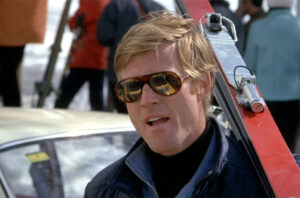
One of the knocks Redford would endure over the years is how, as an actor, he wouldn’t take on roles that worked against his “image,” preferring to play it safe (he was also turned down for roles because of this; Mike Nicholas, who directed Redford in the stage version of Barefoot in the Park, wouldn’t cast him as Benjamin Braddock in The Graduate because he didn’t think Redford would be turned down by a woman). That knock wasn’t entirely deserved. The same year Butch came out, Redford appeared in another Western, Tell Them Willie Boy is Here, the first movie Abraham Polonsky directed since being blacklisted (his last film as director was the 1948 movie Force of Evil, though he had co-written the Don Siegel cop drama Madigan, from 1968). An allegorical film (Redford plays a sheriff named Cooper, clearly modeled on Gary Cooper), the film can be heavy-handed at times, but Redford leans into the politics of the movie, not the last time he would do so. That same year, Redford also worked behind the camera for the first time, starring in and producing Michael Ritchie’s Downhill Racer, the first of two movies the two did together. In this film, Redford played David Chappellet, who’s competing for the Winter Olympics in downhill skiing. At first glance, it may seem like Redford may be playing into his image, as Chappellet is a winner, as well as a glamour figure who gets involved with other women (Wood, who appears in one of the crowd scenes, also served as an uncredited production assistant). However, Chappellet is arrogant about the sport, with his other teammates (putting him in conflict with Eugene Claire (Gene Hackman), his coach), and the women in his life, and though he ends up winning at the end, the movie doesn’t set him up for a phony redemption. Redford does a good job portraying all of that, so Chappellet doesn’t just come off as a hotshot skier.

While The Hot Rock (1972), Peter Yates’ underrated adaptation of Donald E. Westlake’s first Dortmunder novel, showed Redford’s comic side to good effect (Goldman adapted the novel), especially in his first scene (when the warden about to release Dortmunder asks him to go straight for a change, Dortmunder responds, “My heart wouldn’t be in it, Frank”), it wasn’t a hit at the box office. That same year, Redford continued to stretch. Jeremiah Johnson was another western that reteamed him with Pollack, but while this biopic about the titular mountain man, co-written by John Milius, did well at the box office and earned decent reviews, it had too much of the macho posturing Milius was fond of for my taste, and while Redford was clearly comfortable playing an outdoorsman, he seemed uncomfortable with that posturing (John Huston’s The Life and Times of Judge Roy Bean, which came out that same year and was also co-written by Milius, plays better for me because Huston and Newman, cast in the title role, kidded that posturing). Much better, for me, was The Candidate, from that same year, which reteamed him with Richie and played into Redford’s politics. He plays Bill McKay, the title character, who runs for senator of California (against a Republican incumbent who’s considered a sure thing) just so he can say want he wants, only to watch as Marvin Lucas (Peter Boyle), a political consultant running the campaign, forces him to tone down his beliefs, which leads him to winning the election, leading to the memorable last line, “What do we do now?” Redford again plays both the comedy of the situation (the scene where he rails against the triteness of his speeches while riding in a limo) and the drama (he looks genuinely unnerved at the end), which helps make the movie (sharply written by Jeremy Larner and directed by Ritchie) all the more effective.

The following year, 1973, brought forth two of Redford’s biggest hits, both of which had him working with familiar people. The Sting reunited him with Hill and Newman for a period comedy where he plays Johnny Hooker, a con artist whose mentor Luther Coleman (Robert Earl Jones) is murdered by gangster Doyle Lonnegan (Robert Shaw) after Hooker and Coleman inadvertently con one of Lonnegan’s men out of a lot of money. Hooker ends up working with an old associate of Coleman’s, Henry Gondorff (Newman), to try and con Lonnegan out of his money. While Redford was criticized in some quarters for being too old to play Hooker, he brings an insouciant charm to the role (as when he’s trying to pretend he’s betraying Gondorff, known to Lonnegan as “Shaw,” to Lonnegan) along with a real anger (when he tells Gondorff he’s going to get Lonnegan because he doesn’t know enough about killing to kill him). The movie was slammed in some quarters for being just a copy of Butch Cassidy and the Sundance Kid, but in my opinion, it’s much better.

Later that year, Redford teamed up with Pollack on their third movie together with The Way we Were, where he plays Hubbell, a writer who becomes involved with Kate (Barbra Streisand), a politically-minded former classmate of his (the movie takes place before and after World War II). I must confess I’m not a big fan of this movie; I’ve never been a fan of Streisand, and while I think she plays the role rather stridently, Arthur Laurents (who adapted his own novel for the screen) also writes her in a one-note fashion (Pollack and Laurents also lose their way when depicting those fighting against anti-McCarthyism). On the other hand, while Redford is playing a character he’d play again – the man who doesn’t commit politically even though he loves someone who does – he makes him self-aware. Kate, who was initially dismissive of Hubbell in college, starts to take him seriously when their teacher reads aloud an essay where Hubbell describes how easy things came to him, and the way Redford reacts during that scene shows a self-awareness and a reluctance to draw attention to himself.
The following year saw Redford appear as the title character as Jack Clayton’s adaptation of F. Scott Fitzgerald’s The Great Gatsby. While I’ve said before how I try not to be someone who automatically feels “the book was better” when it comes to movie adaptations, I also must admit I haven’t liked any of the movie versions of Fitzgerald’s novel that I’ve seen, from the 1949 version (directed by Elliot Nugent, with Alan Ladd in the title role), to the 2013 version (directed by Baz Luhrmann, with Leonardo DiCaprio in the title role) to this version. Redford certainly looks glamorous enough to play Gatsby, but he seems ill at ease the entire time he’s on screen (whatever the faults of the 2013 version, which were many in my opinion, DiCaprio never had that problem). Goldman would later claim Francis Ford Coppola’s adaptation of the novel was wonderful but Clayton did a poor job directing the material; for me, despite good performances by Sam Waterson as Nick Carraway and Lois Chiles as Jordan Baker, the whole thing comes off as a botch job.

As in 1973, Redford reunited with Hill (for the third and final time) and Pollack (for the fourth time) in 1975. For Hill, Redford played the title character in The Great Waldo Pepper, a tribute to barnstorming pilots, written by Goldman and Hill. Goldman would claim the movie didn’t connect with audiences because they never forgave the fact Redford, as Pepper, failed to save a woman’s (Susan Sarandon) life during a flying stunt, which is too bad as I think it’s underrated, a very good portrait of the cost of chasing dreams when you may have outgrown them, and Redford is good at playing the boyishness of Pepper’s early years as a pilot to his weariness after Pepper has faded into obscurity. For Pollack, Redford switched gears for the thriller Three Days of the Condor, adapted from James Grady’s novel Six Days of the Condor. Redford plays Joe Turner, a reader for the CIA (or a CIA front) who comes back from getting lunch for his colleagues at work one day only to discover they’ve all been murdered, and his own bosses may have been involved. While the movie has rightly come under fire for the Stockholm-syndrome romance plotline – Turner becomes briefly involved with Katherine Hale (Faye Dunaway), a photographer he kidnaps when he needs a place to lay low – Pollack makes the rest of the movie a taut and enjoyable thriller. Redford’s not the standout of the movie for me – that’s Max Von Sydow as Joubert, the blissfully amoral professional killer who tries to kill Turner but ends up helping him instead (“I don’t interest myself in ‘why.’ I think more often in terms of ‘when,’ sometimes ‘where,’ always ‘how much.'”) – but Redford again shows believable anger (especially when he chews out Higgins (Cliff Robertson), one of his bosses at the CIA, when he founds out how deeply Higgins was involved with what happened) and manages to be convincing as someone who’s a hero because they’re able to think on their feet, not because of any physical acts.

Like other actors in the 1970’s, Redford had become active politically, though he kept a lower profile than people like Warren Beatty and Jane Fonda. But he saw a chance to combine politics and movies in 1976 with Alan J. Pakula’s All the President’s Men. I wrote about this movie several years ago for a blogathon, but I’ll just say the movie depends in large part on the relationship between Bob Woodward (Redford) and Carl Bernstein (Dustin Hoffman), and Redford and Hoffman make that work wonderfully. The following year, Redford was part of an all-star cast (including Michael Caine, Hackman, and Laurence Olivier) who appeared in Richard Attenborough’s World War II epic A Bridge Too Far, and while this movie didn’t work for me (it’s an anti-war movie, yet it seems to glorify violence), Redford does his best with his role as Julian Cook, who led a river crossing during the Battle of Arnhem.
In 1979, Redford teamed with Pollack for the fifth time, as well as Fonda for the first time since Barefoot in the Park, for The Electric Horseman, and then a year later appeared as the title character in Brubaker, directed by Stuart Rosenberg (taking over when original director Bob Rafelson was fired by the studio). In the former, a romantic drama, Redford played “Sonny” Steele, a rodeo champion turned spokesman who decides to steal the horse used in a commercial he’s supposed to appear in, with Fonda playing a reporter who covers his story and later falls in love with him. As with Absence of Malice, which Pollack made two years later with Newman (Sally Field played the reporter in that one), Pollack isn’t able to combine the romance with the message, and both seemed somewhat half-baked (even though he and Fonda do have good chemistry together). The latter finds Redford as a prison warden who goes undercover at first to discover conditions at the prison and then, once he announces himself as the warden (the best scene in the movie), tries to reform it, to no avail. While Redford spars well with Jane Alexander (who plays Lilian, a PR specialist with the governor, who agrees with Brubaker on the problems with the prison but not on how to solve them), and the criticism of for-profit prisons is sadly relevant today, the movie often makes its characters too one-note, and Redford is often too strident in the role.
As an actor, the 1980’s were a good time for Redford on a financial scale, but I don’t think they were on an artistic one, as he seemed to be afraid to go past his image (and not just the movies he did; Redford got let go from The Verdict before Paul Newman and director Sidney Lumet signed on because he wanted to make the main character, an alcoholic lawyer, more likable). First came The Natural (1984), Barry Levinson’s adaptation of the novel by Bernard Malamud, where Redford plays the title character, Roy Hobbs, a baseball player who, 16 years after getting shot, gets a position on the New York Knights (managed by Pop Fisher, played by Wilford Brimley) because he can hit the hell out of the ball. I’m afraid as with The Great Gatsby, this is another case where I thought the novel was better; Malamud wrote Roy Hobbs as an ordinary guy who just happened to be a talented hitter, and by casting Redford, Levinson destroyed the point of the story by making Hobbs a heroic character. Good performances by Brimley, Glenn Close (as Iris, Hobbs’ childhood love interest), Robert Duvall (as Max, a reporter who wants to bring Hobbs down), and Richard Farnsworth (as Red, Pop’s coach) can’t mitigate what Levinson does to the story. Redford then teamed up with Pollack for the sixth time for Out of Africa (1985), the only other Best Picture winner besides The Sting that Redford appeared in, but this docudrama about Karen Blixen (the pseudonym for Isak Dinesen) and her time in Africa. Redford is miscast as Denys, a British man Karen falls in love with, though he is convincing as a big game hunter. Also, the movie suffers from being more interested in the scenery than the characters, not to mention how it seems to celebrate colonialism. The following year, Redford appeared in Legal Eagles (1986), Ivan Reitman’s attempt to show he could make something besides a gag-heavy comedy. Redford, playing Tom Logan, a prosecutor who ends up helping Laura Kelly (Debra Winger), a defense attorney with her client Chelsea (Daryl Hannah), an accused arsonist, has great chemistry with Winger (in a rare comedy), but the movie is too plot-heavy and strains credulity. However, by this time, Redford had already moved into a other crucial phase of his career.

In 1980, Redford took his shot at directing with Ordinary People, an adaptation of the Judith Guest novel about Conrad (Timothy Hutton), a Midwestern teen struggling with feelings of guilt after his brother died in a boating accident (Conrad tried to kill himself because of it) as well as his relationships with Beth (Mary Tyler Moore), his mother, who wants to pretend like the whole thing never happened (and who, as it turns out, loved Conrad’s brother more than she loves Conrad) and Calvin (Donald Sutherland), his father, who wants to help Conrad but isn’t sure how. Unlike his acting work in the rest of the decade, Redford (along with screenwriter Alvin Sargent) seems willing to dig deep into the emotional lives of the characters (especially the final scene between Conrad and Dr. Berger, his psychiatrist, played by Judd Hirsch). The movie has since been pilloried by those who cite it as yet another example of the Best Picture Oscar going to the wrong picture and stealing it from a more deserving winner (Martin Scorsese’s Raging Bull). While I do on balance prefer Raging Bull, I do think Ordinary People is still a terrific movie.

Redford didn’t direct another movie until 1988 with The Milagro Beanfield War, an adaptation of the John Nichols novel (which Nichols shared screenplay credit on with David S. Ward) It tells the tale of Joe Mondragon (Chick Vennera), an out-of-work handyman who, disgusted by his inability to get a job working on the golf course millionaire Ladd Devine (Richard Bradford) is working on (which will drive up the rents and other prices for the residents of Milagro in New Mexico), accidentally kicks a pipe near his father’s old field, leading it to flood, and leading Joe to plant beans on the field. This pits him and the other villagers (eventually) against Devine and the forces he tries to line up against Mondragon, including Montana (Christopher Walken), a government agent intent on getting Devine. Unlike Ordinary People, the movie was not well-received (Roger Ebert gave it a mixed review), nor did it do well at the box office, but I think this is Redford’s most underrated movie as a director. While he’s aiming to make a comedy here, Redford doesn’t sugarcoat the issues, or let the scenery overwhelm the characters. Plus, unlike many movies about non-whites of the time, Redford doesn’t put a white character at the center (there are white characters who help, like Charlie Bloom (John Heard), an ex-lawyer turned newspaper editor whom Ruby (Sonia Braga), the local activist, often has to goad into taking action, and Herbie Platt (Daniel Stern), a sociology student who ends up help Mondragon, but they aren’t the story), and arguably, the main character is Amarante (Carlos Riquelme), Mondragon’s elderly father (though Redford does err in not casting a Latino-American as Mondragon). It’s the rare Capra-esque movie that both feels honest (instead of cloying) and is good to boot.

In 1990, Redford teamed with Pollack for the seventh and final time. Havana is basically a rip-off of Casablanca set in 1958 Cuba, with Redford as Jack, a professional gambler who is gearing up for a big game but ends up helping Roberta (Lena Olin), wife of Cuban revolutionary Arturo (an uncredited Raul Julia). Pollack and Redford are treading familiar ground here, but perhaps since Pollack has cast the movie so well – Alan Arkin (as Joe, a casino owner and old friend of Jack’s), Tomas Milian (as a colonel in the secret police), Tony Plana (as Julio, a reporter friend of Jack’s), Mark Rydell (in a memorable cameo as real-life gangster Meyer Lansky), and Richard Farnsworth (as an elderly gambler and mentor to Jack) all acquit themselves well – it goes down pretty well, and Redford seems completely at ease in his role. Another familiar tale Redford helped make work was Sneakers (1992). Redford plays Martin Bishop, a former computer hacker who now runs a team of security analysts (they break into places to discover how secure they are, and then advise those places how to beef up their security) who’s forced to work for the NSA to steal a black box from Janek (Donal Logue), only to find out (a) the box is actually the ultimate code-breaker, and (b) the true mastermind is Cosmo (Ben Kingsley), Martin’s old friend (whom Martin thought was dead), who wants to use the box to crash the economy. Director Phil Alden Robinson manages the serious aspects and the fun aspects of the movie well, and except for Kingsley (who does an annoying American accent), Redford and the rest of the cast (including Sidney Poitier as an ex-CIA agent, Dan Aykroyd as “Mother,” a conspiracy-minded technology expert, David Strathairn as Whistler, a blind hacker, and Mary McDonnell as Liz, a piano teacher and Martin’s ex-girlfriend) work together well.
The following year, however, brought the nadir of Redford’s acting career. For those who have (mercifully) blocked it out, Adrian Lyne’s Indecent Proposal is the one where Redford plays John Gage, a billionaire who offers David (Woody Harrelson) and Diana Murphy (Demi Moore) $1 million (to help make them financially solvent after they lose everything first in the real estate market and then in Vegas) to sleep with Diana. This was sold as being controversial, but Lyne, who mostly came from the Cecil B. DeMille school of filmmaking (shoving sin in your face and then wagging his finger at you for enjoying it) makes sex, or the idea of it, boring (even my mother, who reluctantly watched the movie because she’s a fan of Redford, found the movie boring), with only Oliver Platt (as Gage’s lawyer) showing any vitality. Lyne even has Gage rip off a moment from Citizen Kane late in the movie. To Redford’s credit, while he’s a complete stiff in the role, he would later disparage the movie and his performance. Also, around that time, his career as director was still flourishing.
Redford’s third movie as director, A River Runs Through It (1992) (adapted from the short story by Norman Maclean), which he also narrated, was dismissed by Rayanne Graf on My So-Called Life when she said, “Isn’t it that boring movie with all the fishing?” However, this tale of two brothers – Norman (Craig Sheffer) and Paul (Brad Pitt) – in 1920’s Montana who share little except a love of fly-fishing is a well-delineated study of brotherly conflict, as well as an authentic-feeling portrait of the time. In addition, Redford gets good performances out of his cast, including Sheffer, Pitt, Tom Skerrit (as their Presbyterian minister father) and Emily Lloyd (as Jessie, a woman Norman falls in love with). Redford and cinematographer Phillipe Rousselot also do a good job not letting the scenery overwhelm the story.

Even better, however, was Redford’s follow-up movie as director, Quiz Show (1994), adapted from Richard Goodwin’s book Remembering America: A Voice from the Sixties. Even if you don’t buy Redford’s notion that the quiz show scandals of the 1950’s – when it was revealed quiz shows such as Twenty-One (the show that’s the focus of the movie) fed its contestants the answers ahead of the show – were when we lost our innocence as a country, he still manages to make this a crackling entertainment. He and cinematographer Michael Ballhaus evoke the period without fetishizing it, screenwriter Paul Attanasio writes both crackling dialogue and pungent scenes (such as when Dan Enright (David Paymer), one of the producers of Twenty-One, refuses to admit to Goodwin (Rob Morrow), who’s investigating the show on behalf of Congress, the network knew the contestants were being fed the answers), and he gets great performances out of his cast. Though Morrow, Paymer, John Turturro (as Herbert Stempel, who blew the whistle on the quiz shows when he was told by the network to take a dive so the show could get a new winner), Hank Azaria (as Albert Freedman, another producer), and Mira Sorvino (as Goodwin’s wife) are all terrific (as is Martin Scorsese, in a rare performance in someone else’s film, as Martin Rittenhome, head of Geritol, which sponsored Twenty-One), but the acting honors go to Ralph Fiennes as Charles Van Doren, the most popular of the show’s contestants (and the longest-running) and Paul Scofield as Mark Van Doren, his professor father. Echoing The Way we Were, Charles, as he testifies before Congress at the end, admits that everything came too easy to him, and Fiennes plays up Charles’ intellectual glamor while also realizing the lies he’s telling (the main conflict of the movie, played well, is while Goodwin has more in common with Stempel than with Charles, he admires Charles but is embarrassed by Stempel), while Scofield is masterly at playing someone who loves his son (and is as intellectually rigorous as he is), but doesn’t understand him.
Another knock against Redford was, as he got older, he continued to play characters younger than he was and who got romantically involved with women much younger. Jon Avnet’s Up Close & Personal (1996) is loosely based on Alanna Nash’s book about TV anchor Jessica Savitch (called Tally in the movie, and played by Michelle Pfeiffer), but got turned around somehow into a quasi-remake of A Star is Born (John Gregory Dunne, one of the credited writers on the film, would later write a book about the experience called Monster). It’s a ridiculous story – Redford plays Warren, a news producer who becomes Tally’s mentor and later lover, but who doesn’t go as far as she does because of his integrity, which would be admirable in real life, but Avnet doesn’t handle it believably. However, despite the age difference, Redford and Pfeiffer have enough chemistry to make the movie pass the time (good supporting performances by Stockard Channing, Joe Mantegna and Kate Nelligan, among others, helps).

Redford’s next film as an actor, The Horse Whisperer (1998), was also the first time he had ever directed himself in a movie, adapting the novel by Nicholas Evans. Redford plays the title character, Tom Booker, who’s living with his brother Frank (Chris Cooper) and his family in Montana when Annie MacLean (Kristin Scott Thomas), her daughter Grace (Scarlett Johansson), and their horse Pilgrim show up from New York. Grace had ridden Pilgrim one morning with her friend Judith (Kate Bosworth) when they got into an accident that killed Judith (and her horse) and badly injured Grace (she has to use a prosthetic leg) and Pilgrim. Annie wants Tom, who she thinks helps people with horse problems (Tom corrects her by saying he helps horses with people problems), to help make Pilgrim better, and the movie is smart enough not to explain that if Tom helps Pilgrim, he’ll also be helping Grace, who’s become moody and withdrawn since the accident (partly due to what she feels is her mother bossing her around, and partly because she feels guilty, and we find out why later). Redford is at his best in the movie when he’s trying to help Pilgrim (using, as far as I can tell, plain horse sense) and when he’s bonding with Grace (and while Johansson is playing a more opening emotional character than she usually does, she’s terrific). It’s the romance between Tom and Annie that doesn’t always come off well (though as with his adaptation of The Bridges of Madison County, Richard LaGravenese, who’s credited on the script with Eric Roth, does a good job paring down the novel’s excesses), not helped by the fact Redford was at least a decade older than Scott Thomas (though she does a good job as Annie).
Still, The Horse Whisperer was a pretty good movie, which is more than can be said of Redford’s next movie as director, The Legend of Bagger Vance. Admittedly, the fact I’ve never been a fan of golf doesn’t help, but this movie about Rannulph (Matt Damon), a golfer and WWI veteran who reluctantly agrees to play a golf match featuring Walter Hagen (Bruce McGill) and Bobby Jones (Joel Gretsch) indulges in a lot of cliches about the sport, including the mysticism. Worse, Redford and screenwriter Jeremy Leven make the title character (played by Will Smith) nothing more than a one-note “Magical Negro” stereotype. Ironically, as he stumbled with directing, Redford started to take more chances as an actor, even if the movies weren’t always successful.

The Last Castle (2001), directed by Rod Lurie, had Redford as Lt. General Irwin, who’s been sent to military prison for defying presidential orders to send his men on a rescue mission in Burundi, which ended up with eight of his soldiers being killed. The main thrust of the movie is the conflict between Irwin and Col. Winter (James Gandolfini), head of the prison.. Like all the movies Lurie did that I’ve seen, it’s rather obvious and heavy-handed (you can tell Winter is the jealous type because he listens to music by Salieri, Mozart’s rival), but as with The Contender and this, Lurie does get to you, thanks to getting good work out of his cast, especially Redford playing a man who may be in the right but is also willing to manipulate others to get them to do right (Gandolfini, who took the movie because he was a big fan of Redford’s, is equally good as a man who does evil things because he’s terrified of being exposed as a fraud). That same year saw Redford acting with Pitt in Tony Scott’s Spy Game. As Nathan Muir, a CIA agent, Redford shows himself again to be a master manipulator as he tries to arrange for his protégé Tom Bishop (Pitt) to be rescued from a Chinese prison (even though his superiors don’t want this to happen) while pretending to help by telling them about Bishop’s file. Redford gives a completely relaxed performance as Muir, but he’s also convincing as a hard-bitten realist until his change of heart at the end. Scott, as usually, indulges in too much trick camerawork, but most of the time, he’s content to let the story tell itself and to follow the actors, resulting in an entertaining movie. In producer Pieter Jan Brugge’s directorial debut, The Clearing (2004), Redford plays Wayne, a business executive kidnapped by Arnold (Willem Dafoe), a former employee of his. The kidnapping part is the weakest part of the movie, as Brugge is frustratingly opaque in these scenes, but Redford works well with Dafoe, keeping up with him every step of the way, and playing the arrogance of his character quite well. And while Lasse Hallstrom’s An Unfinished Life (2005) is, like many of his English-language movies, a high-toned soap opera (though I liked Something to Talk About and much of The Cider House Rules), Redford not only lets himself look his age as Jennifer Lopez’s estranged father-in-law, he really plays the anger of the role (though he has more relaxed moments, as when his granddaughter (Becca Gardner) wonders if he’s gay).

In 2007, Redford turned back to directing with Lions for Lambs, which he also appeared in along with Meryl Streep and Tom Cruise. 2007 was the year Hollywood finally decided to confront the Iraq War (documentary filmmakers and filmmakers from other countries, of course, had already confronted the war), but those movies (including Paul Haggis’ In the Valley of Elah, Brian De Palma’s Redacted, and Gavin Hood’s Rendition) were all flawed, and Redford’s movie was no exception. The Afghanistan scenes, where Arian (Derek Luke) and Ernest (Michael Pena) are two American soldiers trapped behind enemy lines, feel fake, like they were shot in a studio (writer Matthew Michael Carnahan had originally wanted to do it as a play), and you sometimes get the uncomfortable feeling Redford is pulling a “When I was your age” act on a younger audience. Nevertheless, Redford and Carnahan are willing not just to go after those who waged the war, but also those who could have done more try and stop it, but didn’t, especially in the media. Redford also especially is on his directing game in the scenes with Cruise (as Jasper Irving, a Republican senator who claims to have a “new” strategy to win the war) and Streep (as Janine Roth, a writer interviewing Irving), both terrific. Finally, while it may come off as yet another elder mythologizing the 1960’s, the scene where Professor Stephen Malley (Redford) tries to get his student Todd (Andrew Garfield) to do more has lines that still hit me (“Rome is burning, son!”).

If Lions for Lambs was Redford’s flawed but interesting attempt to confront the Iraq War, The Conspirator (2010), based on the true story of Mary Surratt (Robin Wright), the only woman charged in the Lincoln assassination, was his attempt to make an allegory about how the U.S. had changed after 9/11. Unfortunately, it was also his directorial nadir, as every single character was one-note, Redford’s filmmaking was ham-fisted, and no one came across well (the normally reliable Kevin Kline, as Secretary of War Edwin Stanton, came across the worst). Much better was the movie that proved to be his last as director, The Company You Keep (2012). Redford plays Jim Grant, a lawyer who goes on the run when it comes out he’s really Nick Sloan, a former member of the Weather Underground who’s suspected of being involved in a bank robbery where a police officer was killed. Redford cast Shia LaBeouf as Ben Shepard, the reporter who exposes and then tries to track down Sloan, and he’s the weakest part of the movie, hitting only the obvious notes in his performance. However, Redford and writer Lem Dobbs (adapting a novel by Neil Gordon) overall do a good job dealing with the legacy of the 1960’s, Redford mostly avoids the “When I was your age” attitude that sometimes crept up in Lions for Lambs, and he gets good performances out of the rest of his cast, especially Brendan Gleeson as a policeman with a guilty secret and Susan Sarandon as another former Weather Underground member whose arrest kickstarts the plot.

While The Company You Keep was a box office success, Redford decided to turn back to acting for other people. First up came J.C. Chandor’s All is Lost (2013), which is basically Redford on a boat dealing with calamity after calamity after he inadvertently runs it into a stray cargo container. I don’t love the movie as much as others do – I had the uneasy feelings critics were fetishizing the movie because there’s almost no dialogue, as if dialogue by definition always ruins movie – but again, there’s no question for someone accused of caring too much about his image, Redford is willing to let himself go and play without vanity. While Redford had been willing to play unlikable characters, Captain America: The Winter Soldier (2014), directed by Anthony & Joe Russo, saw him play his first villain, as Alexander Pierce, one of the heads of S.H.I.E.L.D., but who is secretly the head of HYDRA, a Nazi organization Steve Rogers (Chris Evans) had fought in WWII (in the first Captain America movie). In interviews, the Russo brothers claim they were influenced by 70’s conspiracy thrillers, which I don’t buy – the point of those movies is you weren’t always sure who to trust and who was your enemy, whereas it’s pretty obvious who the enemy is here – and when it becomes an action movie, it looks like all other comic-book movies, but Redford is terrific as Pierce because he never plays him as a villain, even when he’s exposed, but as someone who is a true believer.
After this, Redford played real-life figures for the first time since Out of Africa. In A Walk in the Woods (2014), he plays Bill Bryson, a real-life travel writer, who decides to walk the Appalachian Trail, accompanied by Stephen Katz (Nick Nolte, whom Redford had directed in The Company You Keep). Director Ken Kwapis plays the comedy too broadly, and as Bryson’s wife, Emma Thompson was wasted on her role, but Redford and Nolte work well together. The following year, Redford took on another real-life figure with Truth, albeit in a more dramatic turn. The film, written and directed by James Vanderbilt, was the true story how “60 Minutes” initially reported then-president George W. Bush had received preferential treatment while in the National Guard during the Vietnam War, told through the yes of Mary Mapes (Cate Blanchett), the producer who ended up losing her job after producing the segment. Vanderbilt’s point, a valid one, was the story was valid and CBS rushed the story before they could get complete validation and then let Mapes and Dan Rather (Redford), who reported the story, hang out to dry. Unfortunately, Vanderbilt makes his points in an obvious way, and unlike another journalism movie from that year, Spotlight, he mythologizes his characters, negating the fine work done by the cast, especially Blanchett. As for Redford, while he doesn’t look or sound like Rather, he is convincing as an anchor.

Redford then made his last filmmaking relationship with director David Lowery. First, Lowery cast him in a remake of the Disney live-action film Pete’s Dragon (2016). While Redford likely took on the role of Conrad – father of Grace (Bryce Dallas Howard), whose son Pete (Oakes Fegley) befriends a dragon in the forest – because he had sympathy with the movie’s ecological theme (Redford was an environmentalist), this also manages to be the rare Disney live-action children’s movie that doesn’t talk down to its audience, and Redford seems happy to play a supporting role. His second, and last, film with Lowery was also his last film (not counting a cameo in Avengers: Endgame), The Old Man & the Gun (2018), where he played Forest Tucker, a career criminal who was as famous for escaping from prison as he was for his exploits, though the film narrows its focus to when Tucker, in his 70’s, develops a relationship with Jewel (Sissy Spacek), a widow, and trying to evade capture from Detective John Hunt (Casey Affleck), who has a sneaking admiration for him. This may be the most relaxed Redford has ever appeared on screen, and the role seems to fit him like a glove. Lowery hypes the story a little bit near the end, but overall, this is a very entertaining film.

While Redford acted in movies for merely 60 years, and directed them in over 40 (he also narrated such documentaries as Incident at Oglala, directed by Michael Apted, about Native Americans – particularly Leonard Peltier – accused of killing FBI agents, and was an executive producer on such movies as Tamara Jenkins’ Slums of Beverly Hills), for me, his biggest legacy when it comes to movies is the fact he founded the Sundance Institute, which started in 1981, where older filmmakers could help new independent filmmakers improve their craft and compete for financial assistance, and as one of the founders of the Utah/Us Film Festival, which would later be known as the Sundance Film Festival. When the latter was started in 1978, it was originally known for showing older movies, but starting in 1981, the festival started to showcase new, independent films and documentaries, and while the emphasis was on American films, the festival also made room for films from other countries. Also, unlike Hollywood for many years, Sundance welcomed movies from women, non-white filmmakers, and LGBT filmmakers. Among the movies we’ve discussed on our show that appeared at the festival are Return of the Secaucus Seven, Ruby in Paradise, Y Tu Mama Tambien, and in upcoming episodes, Big Night and Memento. The Sundance Film Festival was one of the major factors in the independent film movement breaking out after sex, lies and videotape won the main prize at the 1989 festival, and it’s the main reason why there are still movies other than the latest sequel, reboot or remake being made or shown. That, even more than the films Redford acted in and/or directed, is what made Redford such an important figure and why he will be missed.