Lone Star and Mystic River: Written Reviews

In our latest episode, Claude and I talk about two movies where characters must confront their past; Lone Star (1996) and Mystic River (2003). Here’s what I wrote about each of them when writing on Facebook about my favorite movies released in the U.S. in 1996 and 2003, respectively.

Chris Cooper (Sam Deeds) and Elizabeth Pena (Pilar Cruz)

I own a book called Legends, Lies and Cherished Myths of American History, by Richard Shenkman, published over 30 years ago. As the title indicates, it purports to tell the truth behind a lot of what we were taught in history classes growing up (about politicians, family life, famous sayings, and more), What we are taught about our country’s history has become a hot topic again as there is renewed, and welcome, debate about who we choose to honor through a statue (or having a place named after), as well as who we choose to put the spotlight on when it comes to our history, especially if it marginalizes people of color and women. The way we view history also relates to personal history as well a country’s history; one person may only have happy memories of their parents, while that person’s sibling may think otherwise. Personal and political history are the subject of John Sayles’ Lone Star, one of his best movies.

The title of the movie refers to the slogan of Texas, which is where the movie takes place, specifically Frontera, a small border town near Laredo, and near an army base. Cliff (Stephen Mendillo) and Mikey (Stephen J. Lang, not to be confused with the Stephen Lang from Avatar), two sergeants from the base, are out treasure hunting one day in a deserted shooting range when they find an old sheriff’s badge, a Masonic ring, and a human skull (later, they also find a bullet). Sam Deeds (Chris Cooper), the town sheriff, is able to confirm the badge, ring and skull all belonged to Charlie Wade (Kris Kristofferson), the former sheriff of the town 40 years earlier, a corrupt man who had ruled the town with an iron fist, and who had mysteriously disappeared one night, along with $10,000, after a confrontation with Buddy Deeds (Matthew McConaughey), Sam’s father and one of Charlie’s deputies. While the townspeople relish this story, and Buddy (whom they’re dedicating a courthouse to), Sam has always resented his father, ever since he broke up Sam’s teenage romance with Pilar (Elizabeth Pena), now a schoolteacher, single mother, and widow. As Sam begins to investigate the circumstances surrounding Charlie’s death, he believes Buddy was the one who actually killed Charlie, though it may be he just wants that to be true.

Kris Kristofferson (Charlie Wade)

Sayles also sets up a parallel story involving Col. Del Payne (Joe Morton), the new commanding officer of that army base, which is getting shut down in the near future. While stationed at the base, Payne has to handle an incident involving Athens (Chandra Wilson), one of the soldiers on the base, at a nearby bar (two men get into a fight over her). That incident brings Col. Payne back into the orbit of his estranged father Otis (Ron Canada), who owns the bar where it happened (the colonel’s son Chet (Eddie Robinson) was also at the bar that night, though only he and Otis know that) – and who also, as it happens, is connected to Charlie Wade and Buddy Deeds. Payne resents his father for his womanizing and for abandoning his family, only to realize there’s a lot more to his father than he thinks.

Again, history runs throughout the movie. Pilar is a history teacher, and there’s a scene where she and other faculty members get into an argument with school board members about the history textbooks, with whites wanting only their view of history to be taught (a fight that continues to this day). Otis is a history buff, with a room in his bar devoted to pictures and books about his African-American and Native-American ancestry, which he shows Chet. Then there’s Buddy’s history, with Hollis (Clifton James), once a deputy under Charlie, now the town mayor, being the keeper of Buddy’s legacy and the teller of his stories. Hollis and Mercedes Cruz (Miriam Colon), Pilar’s mother, who owns a Mexican restaurant, are the ones behind the push to name the courthouse after Buddy, even though Danny (Jesse Borrego), a local reporter, has a story Buddy evicted Mexican residents of a local community in order to create lakefront property for a tourist attraction that Buddy and Hollis profited from. However, most people Sam talks to about Buddy, including Otis and Minnie Bledsoe (Beatrice Winde), whose husband owned that bar before Otis did, maintain Buddy always dealt with people fairly (as Otis says, “I don’t recall a man in this county – black, white, or Mexican – who’d hesitate for a minute to call on Buddy Deeds to solve a problem”).

Joe Morton (Col. Del Payne)

Sayles, who as usual, edited the movie as well as writing and directing, and cinematographer Stuart Dryburgh don’t do much to differentiate between a scene taking place in the present and one that takes place in the past; no sepia tones, no dissolves, just panning the camera over to signify a transition from past to present and back again. However, in the context of this movie, it works because it helps illustrate how the past is still alive for many of the main characters, and how they like, or need, to hold on to it. Whether it’s Otis telling the story of what really happened to Charlie Wade the night he disappeared, and Dryburgh pans over from the bar in the 90’s to the bar in the 50’s (Gabriel Casseus plays the younger Otis), or, in a poignant moment, when Sam and Pilar talk by a stream, and after she leaves, the camera pans over to a young Sam (Tay Strathairn, son of Sayles regular David Strathairn) and Pilar (Vanessa Martinez, who went on to appear in two more Sayles movies) talking, and then the camera comes back to Sam.*

Along with the history, Sayles throws in the tropes of the mystery film – did Buddy actually kill Wade and take the money? – and the western, with the lone sheriff ruling over the town (Charlie Wade), as well as the lone sheriff trying to investigate what he thinks is the dark secret of the town despite opposition (Sam). The mystery is pretty straightforward, with Sayles playing fair throughout, though it does mean it’s easy to figure out who really killed Charlie Wade (there’s another secret that gets revealed by the end of the movie, and while Sayles plays equally fair with that one, the revelation of that secret is a total surprise; when I saw the movie in the theater when it came out, the audience I was with gasped at the reveal). At the same time, Sayles pays attention to the other stories equally well. He even gets some humor into the movie. Cliff is dating Priscilla (LaTanya Richardson), another sergeant on the base, and when Mikey wonders if her family will accept the fact he’s white, Cliff responds they’re just happy it proves she’s not a lesbian, to which Mikey responds, “It’s always heartwarming to see a prejudice defeated by a deeper prejudice.” When Sam says he’s going to “go over to the other side”, Ray (Tony Plana), his deputy, wonders, “Republicans?” Of course, mostly, it’s played for drama; when Athens fails a drug test, and Col. Payne wonders why she’s in the army in the first place, she responds, “They pay us, sir” (as Sayles points out in the book-length interview book he did with Gavin Smith, many people of color join the military precisely because it gives them a job and more opportunity for advancement than in the private sector), and Sayles also gets into the issue of Mexicans coming across the border, as Mercedes reluctantly helping her busboy’s wife come across, and she remembers how she came across the same way. The score by Mason Daring, Sayles’ frequent composer, also brings together the mélange of musical styles down in Texas, although the best musical moment comes from a prerecorded song; when Sam and Pilar dance to Ivory Joe Hunter’s “Since I Met You Baby” at Miriam’s restaurant.

Cooper, who had previously worked with Sayles on Matewan (as well as in a small role in City of Hope), is playing to the type of another famous actor with the last name of Cooper who was associated with westerns, but he plays it well, and shows what a good listener he is (his role is mostly reactive). Pena, who had appeared in Shannon’s Deal, the show Sayles created, gives a forceful performance as Pilar, and she and Cooper have very good chemistry. Kristofferson is cagey and menacing as Charlie Wade. Morton, as with his character in City of Hope, is playing someone caught between two worlds, and handles it well again. And the rest of the cast, including Frances McDormand as Sam’s ex-wife, is very good in their roles. Though Sayles has continued to make good, or at least interesting, movies, Lone Star remains the last time he hit the peak of his talent as a filmmaker, as well as a sobering reminder about the way history informs everything we do.

*-In another scene with the younger Pilar and Sam, Sayles also throws in an homage to his B-movie roots; the movie the two watch at a drive-in before Buddy catches them is Black Mama, White Mama, a prison exploitation version of The Defiant Ones starring Pam Grier and co-written by Jonathan Demme.

Jimmy Markum (Sean Penn)

(Note: this review of Mystic River was originally written for the fanzine CAPRA in 2003, and is followed by corrections and additional thoughts)

Clint Eastwood’s latest movie – after the entertaining but somewhat routine Space Cowboys and Blood WorkMystic River, adapted by Brian Helgeland from the novel by Dennis Lehane, starts out with three boys who are friends, Jimmy Markum, Dave Boyle, and Sean Devine. One day, when the boys decide to carve their names on the sidewalk, two men who present themselves as cops come up, chew the boys out, and tell them to get in their car. Dave gets in the car, but something tells Jimmy and Sean to stay away. So Dave, of course, is kidnapped and molested, until he finally escapes and comes home. But even though he’s given a hero’s welcome, he, along with Jimmy and Sean, know that glory will be short-lived. 25 years later, Jimmy (Sean Penn) is an ex-con who runs a convenience store, is married to Annabeth (Laura Linney), whom he married after his first wife died, and has three daughters. Dave (Tim Robbins) is a handyman who is married to Celeste (Marcia Gay Harden), and has a son. Sean (Kevin Bacon) is a homicide detective who is separated from his wife. All of them, in other words, are living on a fragile edge. The three come back together when Jimmy’s oldest daughter, Katie (Emmy Rossum), is murdered. Sean is the detective assigned to the case, along with his partner Whitey Powers (Laurence Fishburne). And Dave came home the night of the murder with blood on his clothes, and while he told a story of facing down a mugger, Celeste doesn’t believe him, and she, along with Whitey, and even Sean and Jimmy, begins to suspect him, especially when he reveals he saw Katie before he died.

Back in 1992, when Eastwood made Unforgiven, a lot of critics saw this as his repudiation of The Man With No Name character he played in the spaghetti westerns he did with Sergio Leone. Similarly, some have seen this film as turning his back on his Dirty Harry character and the idea of vigilante justice. There are only three acts of violence shown in the entire film – and interestingly enough, none of them are Katie’s murder – and none of them are cathartic. Not only that, but one of them ends up against someone who’s innocent, and the person who commits this act gets off scot-free. This is miles away from the charge we get from revenge killings in other movies, and it’s certainly to Lehane, Helgeland, and Eastwood’s credit that they go for this more complex view of justices. The closest Eastwood ever came to this before was in his film Tightrope, where his detective character shared some of the same proclivities as the serial killer he was after, but it’s not as deeply explored as it is here.

Kevin Bacon (Sean Devine)

Still, while all of that is admirable, it’s the sense of personal history that makes this resonate. All of these characters, perhaps wounded by their own history, are reluctant to open up until Katie’s death (except, of course, for Whitey, the only one not from the neighborhood). And once that happens, you sense how the incident from the car still haunts them. Katie had been planning to run away with Brendan Harris (Tom Guiry), the one boy Jimmy absolutely forbade her to see, and we soon find out that’s more than just Jimmy being a naturally protective father. Later, after Katie is dead, Jimmy confesses aloud, “I know in my soul I contributed to your death; I just don’t know how”. As for Dave, he refuses to talk about his past to Celeste, and refuses to think about it, except in his nightmares. When he does finally talk about it, he can only talk about it in the third person, calling himself The Boy Who Escaped From Wolves (literally here; in the flashbacks, when he’s escaping, we hear wolves howling), which scares Celeste even more. The only person trying to escape the weight of the past is Sean. His ex-wife calls him on his cell phone, and while she never says anything, he attempts to try and make sense of where they went wrong, and how it can be fixed.

One charge that’s stuck with Eastwood his entire career is how inexpressive he is, and how inexpressive the actors who’ve worked under him are (partly this is blamed on his penchant for few takes; what he sees as spontaneous, others see being afraid to dig deep). He’s managed to become more than just a clenched-teeth actor in the last decade, however, and that’s certainly not a charge you can lay at this movie. Penn throws himself into his role with characteristic resolve and honesty, especially in the scene where he cries, without even knowing it, for Katie. Robbins uses his height to his advantage here, playing Dave as a wounded giant who seems weighed down by his past. Bacon is the surprise here, relying on none of his mannerisms, and being convincing as the cop. Fishburne is appropriately flip and smart as Whitey. Some have criticized Linney’s performance, especially for a Lady Macbeth type moment near the end of the movie. Granted, her character is better developed in the novel but I think Linney brings her usual toughness to the role, so that final speech didn’t seem out of place. And it’s almost unbearable to watch Harden here. If Annabeth is like a proud, stern eagle, Celeste is the frightened, fragile dove, and Harden nails that aspect. Much has been made of the last scene, a parade, where Sean gives Jimmy a chillingly ambiguous look, and while that’s a powerful moment, I think the look exchanged between Annabeth and Celeste right before is even more powerful.

Tim Robbins (Dave Boyle)

Eastwood also wrote the music, and my one complaint with the movie is his excluding Rickie Lee Jones’ “Pirates (So Long Lonely Avenue)” from the soundtrack (in the novel, it’s the song Jimmy and Annabeth first danced to, and if there’s anybody who fits Jones’ idea of “sad-eyed Sinatras”, it’s Jimmy). But for the most part, we get the richness of Lehane’s novel, not just in the characters, but the sense of the neighborhood and its history. All of that comes together in the crowning achievement of Eastwood’s career.

So, a big error right off the bat; Dave gets into the car at the beginning instead of Jimmy and Sean because the fake cops (one of them played by John Doman, best known to me as Rawls on The Wire) say they’re taking him home to his mother, whereas Jimmy and Sean’s parents live right on that street. Also, I should have mentioned the changes from the novel, other than that Rickie Lee Jones song being cut out, and the parts of Annabeth and Celeste being cut down (though Eastwood reportedly told Helgeland, to beef them back up somewhat); Jimmy’s last name is changed from Marcus (in the novel) to Markum, he, Dave and Sean are trying to pull a hockey puck from the sewer when the fake cop comes by, not writing their names in the cement, and there are scenes establishing the three main characters as adults that aren’t in the novel (Jimmy at the store with Katie, Dave walking the streets of his old neighborhood with his son, Sean and Whitey at a different crime scene on a bridge). I also should have mentioned how Eastwood insisting on shooting in Boston lends authenticity to the movie, as well as cinematographer Tom Stern’s fine work in capturing the locations (Stern has shot most of Eastwood’s films since Blood Work). Also, one nice bit of trivia; Kevin Chapman, who plays one of the Savage brothers (the crooks who work with Jimmy), and who went on to appear in Brotherhood, the Showtime series that was one of the best shows of the 2000’s, also appeared in a small role in 21 Grams.

A couple of other things to mention. First of all, of course, there’s been quite a pushback against Penn’s performance, saying it’s overacting to the nth degree, and quite bad (I won’t dignify the other term it’s been characterized as by using it, as I’m sick to death of that term, as I’ve mentioned before). Good overacting and bad overacting, to me, is in the eye of the beholder; I’m the one who thinks Anthony Hopkins does awful overacting in Bram Stoker’s Dracula, while a lot of people I know really like him in that, so I can only say I disagree about Penn here. Secondly, Eastwood’s career went down some interesting paths for the rest of the decade, but in this past decade, he seems to have taken a turn towards simplistic readings of the material he chooses. Still, I do think Mystic River still holds up.

Short Subject: Recent Changes at Turner Classic Movies

In this mini-episode recorded on June 27, Sean and Claude talk about the recent staffing changes over at Turner Classic Movies and the impact it’s having on people, not only the viewers but the people who are so intimately involved with the medium, such as Martin Scorsese and Steven Spielberg. Listen in, and worry along with us.

Incidentally, some sharp-eyed viewers (me among them) noticed that the TCM hosts have stopped doing commentary after the films, and took that as a bad sign. Fortunately  the complaints were heard, and the “outros” will return. Because of the long lead time from production to airing, Ben Mankiewicz will be back in September, and Dave Karger and Alicia Malone will return to outros in October.

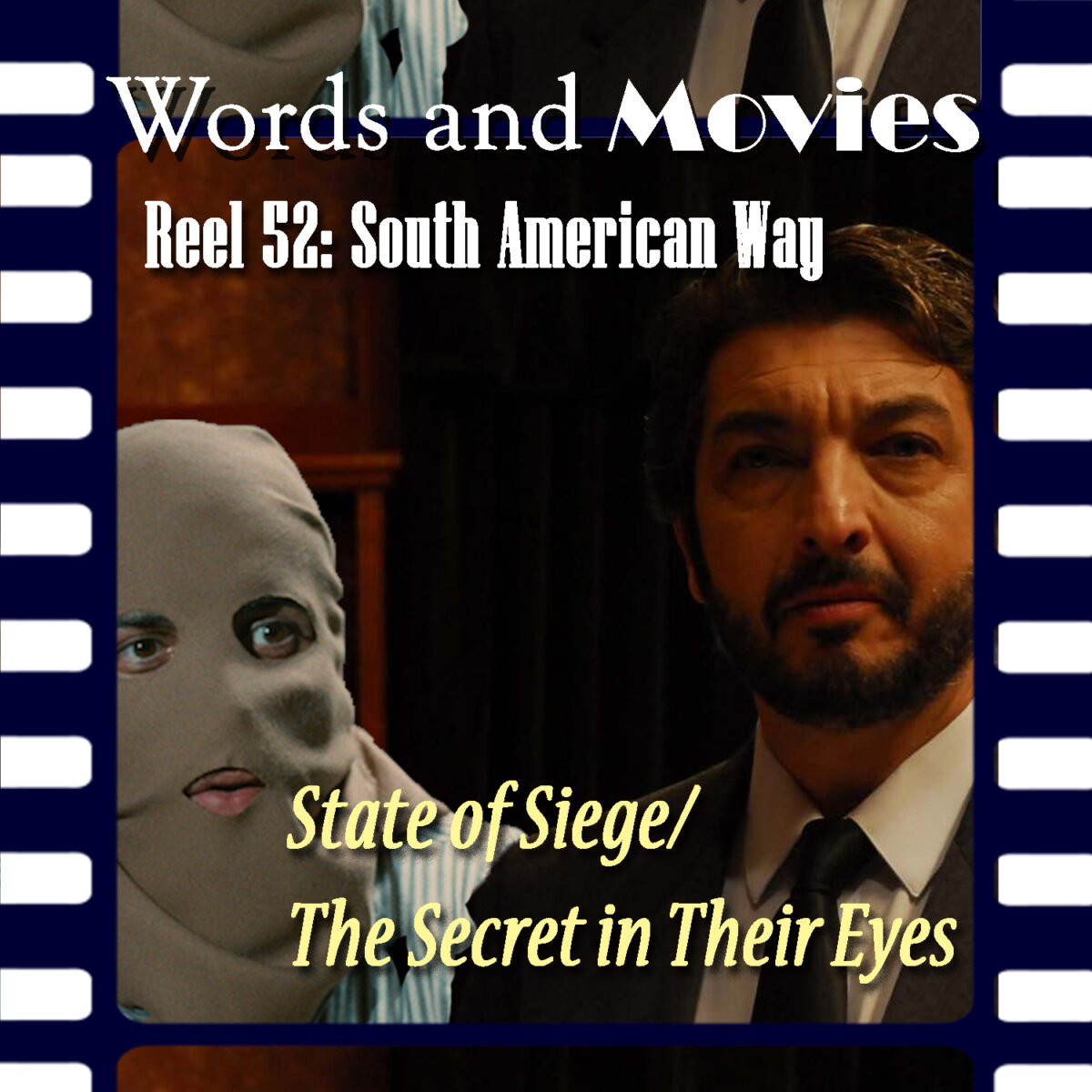
Reel 52: South American Way

¡Hola, amigos! Welcome to Reel 52, wherein we take our tour Around the World in 20 films down to South America!

In Part 1, we’re in an unnamed South American country that’s totally not Uruguay, in the 1972 film State of Siege, directed by Costa-Gavras. It’s a film where you (mostly) know the ending right from the jump. However, you still find yourself rooting for a different outcome throughout. And despite the film’s not committing to a location, this is in fact based on a true story.

Part 2 brings us to Chile and the film The Secret in Their Eyes, a 2009 film directed by Juan José Campanella. It’s a haunting story about a haunted man and a many-years-old mystery. Ricardo Darin and Soledad Villamil star as a star-crossed couple (back in the day) who are brought back together by a new clue in case. It’s got an ending that will both surprise and horrify you. And yet, the breadcrumbs were there for you to find all along.


COMING ATTRACTIONS: 

Next time around, we’ve got a couple of films that play with the characters’ minds and their personalities. And by the end, yours might be affected as well. From 1966, it’s Ingmar Bergman’s Persona. Then, from 1970 it’s Performance, directed by Donald Cammell and Nicolas Roeg. It was actually produced in 1968 but Warner Brothers got a little nervous about the content.

Short Subject: Around the World in 20 Films

The next ten episodes are going to cover a variety of foreign films from all over the world. Sean went through a very meticulous process to curate this particular list, and in this mini-episode, we’re going to chat a little bit about what first got us interested in foreign films, and the criteria that he used to select these titles. 
Addendum: Sean noted on Facebook…
A couple of things I wish I had remembered for this introduction (although I think I talk about this in some of the subsequent episodes) – movies from other countries made an impact here starting after WWII because took on characters and subjects Hollywood under the Hays Code was unwilling or unable to touch (and treat those and other subjects in a more adult way than Hollywood was willing and/or able to do), and movies from other countries also appealed because they told their stories in a different way than Hollywood movies. Although the Hays Code is long gone, and American independent movies have picked up the slack somewhat, I still feel movies from other countries offer a fresh perspective on subjects, storytelling, and just a different perspective.

COMING ATTRACTIONS: 

We start our tour by going South of the Border, down Mexico way. We’ll be reviewing Y tu mamá también, a wild little coming of age road film from 2001. Then we’ll be looking at Roma, a story about the life of a housekeeper in Mexico City. Both of these films were directed by Alfonso Cuarón, who chose to release Roma only to Netflix to ensure the largest possible audience.

Michelle Yeoh: An Appreciation


Michelle Yeoh plays a superhero in 'Everything Everywhere All at Once' : NPR

We’ve talked on our show about a handful of movies from Hong Kong, as well as how Hong Kong movies became popular (at least on a cult level) in America in the 1980’s and 1990’s. That popularity led to Hollywood recruiting some of Hong Kong’s stars (Jackie Chan, Chow Yun-Fat) and filmmakers (Tsui Hark, John Woo) to make movies for them.

Unfortunately, for the most part, Hollywood didn’t really know how to use the filmmakers. Woo, for example, only made one movie – Face/Off – that could compare to the quality of his Hong Kong movies. The stars didn’t fare much better: Chan managed to appear in a couple of hit franchises (the Shanghai movies, the Rush Hour movies), but most of the stars and filmmakers, after trying to work in Hollywood, eventually came back to Hong Kong. Even Chan has returned. The one star who made it big in Hong Kong during that time who has managed to make a successful career in Hollywood has been Michelle Yeoh, and it was still a long, sometimes bumpy road for her, but an ultimately rewarding one as she became the first Asian actress to be nominated for Best Actress at the Oscars this year for Everything Everywhere All at Once, and is a favorite to win.

Like Ziyi Zhang, who co-starred with her in two movies, Yeoh trained as a dancer, studying ballet until she was 15, when a spinal injury curtailed any dreams of becoming a professional dancer. And like Zhang, Yeoh has used her dancing skills and training in many of her roles in the genre she’s become most associated with, the martial arts movie (both historical, or “wuxia”, and modern-day). When American action stars claim in interviews they do their own stunts—or if the movie’s publicity material or IMDb trivia page makes that claim—it’s an exaggeration 99% of the time. Most actors aren’t qualified to do their own stunts, and insurance companies would never let them get away with it anyway. In Hong Kong, out of cost reasons—at least in the 80’s and 90’s—stars did their own stunts, including Yeoh, and while she suffered numerous injuries, they are convincing throughout, and the fight scenes look better and less mechanical than ones in American action movies, which also helped actors like Yeoh shine even from the beginning.

The following is meant not to be a definitive profile of Yeoh’s career – I’ve only seen clips of her work on Star Trek: Discovery, for example, though what I saw of her was impressive—especially since a lot of her Hong Kong work is either unavailable at all or unavailable in subtitled form (I was hoping to revisit Wing Chun, a 1994 martial arts movie, for example, but it’s only available on YouTube without English subtitles), but I hope it will serve as a suitable overview of her work, and illustrate why I think she’s so good.

Magnificent Warriors (1987)
As Ming-Ming in Magnificent Warriors

Her first starring role, Yes, Madam (aka In the Line of Duty), showcased her ballet skills when it came to her action scenes. Yeoh (billed as Michelle Khan) plays Inspector Ng, a Hong Kong detective who reluctantly teams up with Scotland Yard Detective Inspector Carrie Morris (Cynthia Rothrock, in her film debut) to solve a murder and stop a mob boss. Already, director Cory Yuen and Yeoh show off how her ballet moves make her fight scenes entertaining to watch. In the climax, when Ng and Morris take on the minions of the mob boss, Yeoh swings from a railing, does the splits, does a somersault in the air, and more as she fights them off. It’s thrilling to watch. The rest of the film doesn’t quite measure up, as Yuen isn’t able to make the humor and action work together (though producer/director Tsui Hark, in a rare acting role, is fun as a thief), and Yeoh’s acting skills aren’t quite up to her action skills, as she goes too over-the-top.

Her follow-up movie, Royal Warriors, has her Inspector Yip team up with a Japanese Interpol agent (Hiroyuki Sanada) and a Chinese sky marshal (Michael Wong) to foil a hijacking, only to find themselves targeted by the associates of the hijackers. Once again, Yeoh struggles somewhat with the dramatic scenes, especially when Inspector Yip becomes angry and motivated by revenge after a death. However, her fighting skills (which she’s described interviews as “Michelle style’) again are showcased well, using both swordplay (a wooden katana, though of course it’s not much use against real swords) and her fists and legs, especially in the bar fight scene.

Much better is the similarly-titled Magnificent Warriors. This movie sees Yeoh as Ming-Ming, an Indiana Jones-type spy, and daughter of a Chinese rebel, who teams up with another agent, a con man, a rebellious princess, and a local aristocrat to try and thwart the Japanese in 1930’s Tibet (or nearby). Again, the drama and comedy don’t quite work together, but Yeoh seems less awkward  and more involved when it comes to acting. For instance, when she and the others attempt to flee the Japanese and are foiled when a soldier throws a stick of dynamite into their jeep, causing it to crash, she gives a look of calm resignation. And again, Yeoh acquits herself well in the fight scenes, even getting to use a machine gun at the beginning of the movie.

PopGap #06: Police Story 3: Supercop (1992)
With Jackie Chan in Supercop: Police Story 3

After marrying Dickson Poon, co-founder (with Sammo Hung) of D&B Films (which released Yes, Madam, among other films), Yeoh temporarily retired from acting, but when the couple divorced in 1992, director Stanley Tong, a friend of hers, reached out to her and suggested she get back into acting in a film he was directing. That film, Supercop (also known as Police Story 3), ended up teaming her with the most famous martial arts actor at the time, Jackie Chan. In this installment, Chan returns as Inspector Chan, a Hong Kong cop who is sent to mainland China to team up with Inspector Jessica Yang (Yeoh, billed again as Michelle Khan) to stop a drug kingpin. Tong doesn’t combine the humor and drama of the story the way Chan, as director, did in the first two Police Story movies, and once again, Maggie Cheung is wasted on the role of Chan’s jealous girlfriend. Still, Chan and Yeoh have an easy rhythm together, especially when Yeoh is pretending to be Chan’s sister and the two have to pretend to have a brother/sister squabble to maintain their cover. But, of course, the movie is best known for its action scenes, and they deliver. While Brigitte Lin had done some martial arts moves in a couple of scenes from the first Police Story movie, Chan in general at the time thought women didn’t belong in fight scenes, but Yeoh convinced him otherwise. Her most famous stunt, of course, is when Inspector Yang drives a motorcycle onto a moving train to help Chan catch the bad guys. She also has a terrific fight scene when she’s pretending to fight off Chinese army officers so Chan can get in good with the drug kingpin.

How did Michelle Yeoh get her start as an action star? | South China Morning Post
As Siu Lin in Tai Chi Master

The following year, Yeoh appeared in a film with another famed martial artist from Hong Kong, Jet Li – Tai Chi Master, directed by Woo-Ping Yuen. The wuxia film, which Li also produced, isn’t as strong a vehicle for him as the first installments of Once Upon a Time in China or Fong Sai-Yuk, but it gives Yeoh her most dimensional role up to that point in her career. She plays Siu Lin, a woman who ends up teaming up with Li’s Zhang Junbao (thought to be the inventor of Tai Chi martial arts) with rebels against a tyrannical governor and against Junbao’s childhood friend Tienbo (Chin Siu Ho), who has become power-mad. Yeoh does hold her own in fighting (and unfortunately, as in Royal Warriors, is a Damsel in Distress at one point, though at least she’s able to get out of it on her own here), but she also gets more dramatic scenes to work with that show her coming into her own as an actress, as when she’s drowning her sorrows over the fact her husband has left her for another woman, or when she’s trying to help Junbao after he’s regressed mentally at the shock of Tienbo’s betrayal against him. She and Li don’t have the same type of relationship as she and Chan did in Supercop, but they also work together well.

The Heroic Trio - Movie Review - The Austin Chronicle
With Maggie Cheung (left) and Anita Mui (center) in The Heroic Trio.

Yeoh’s best work in Hong Kong films for me, however, came in The Heroic Trio (which came out that year) and The Stunt Woman (which came out three years later). The former, a fantasy movie directed by Johnnie To, teams Yeoh with Cheung and Anita Mui (the late pop singer/actress) as the titular trio. Yeoh plays Ching, also known as Invisible Girl (no relation to Sue Storm from The Fantastic Four), who is working for an evil master (Shi-Kwan Yen) by kidnapping male babies so he can become the new Emperor of China. Ching is also working with an inventor (James Pax) she’s in love with who has been developing an invisibility cloak she uses to commit her crimes, while she’s being pursued by Tung (Mui), also known as Wonder Woman (not to be confused with that comic book character either), a superheroine whom she shares a past with (Cheung plays Chat, aka Thief Catcher, a mercenary who also shares a past with Ching). As with John Woo’s action movies, the plot can sound ridiculous on paper, but it’s the emotion the actors put into their roles, and the story, that makes the movie work. Watch, for example, the way Yeoh looks at Pax when she realizes he’s dying: even though the movie is chaste in portraying their romance, Yeoh clearly shows Ching’s feelings through her eyes and the expression on her face. That also shows in the scene where Ching and Tung recognize each other from when they were children. At the same time, Yeoh also triumphs in the action scenes, as when the evil master’s skeleton (the special effects are admittedly low-rent, but fun) takes over her body and forces her to fight Tung and Chat. Yeoh also works well with Cheung and Mui throughout the movie, including the fight scenes, but she stands out. The Executioners, its sequel, is set in the future, after a nuclear attack has helped make water scarce. Ching, now on the side of good, tries to protect the president (Shan Kwan) from a corrupt colonel (Paul Chun) and an evil demon (Anthony Wong, reprising his role from the first movie). Yeoh’s character arc isn’t as dramatic as of Cheung and Mui, but she’s able to play the most steadfast character here without making her dull, while again showing her prowess in the action scenes.

Watch 'The Stunt Woman' Online Streaming (Full Movie) | PlayPilot
As the title character in The Stunt Woman.

The Stunt Woman is a biopic directed by Ann Hui, and is also known as the movie that nearly got Yeoh killed during a stunt when she fractured her vertebrae doing a jump from a bridge onto a truck (according to Hui, when she visited Yeoh in the hospital, Yeoh said to her, “I’m sorry I ruined your shot”). Yeoh plays Ah Kam, the title character, who joins a stunt troupe who work for director Chief Tung (Sammo Hung, a comic actor who also worked as a director and stunt director). There are also subplots about a gangster who threatens the movie Kam and Tung work on, and how Kam becomes attracted to Sam (Jimmy Ga Lok Wong), a restaurant owner. Though Hui includes elementsfamiliar  to martial arts movies (lots of fight scenes) as well as elements familiar to those who know about the Hong Kong movie industry of the 1980’s and 1990’s (e.g., there were triads involved in the making of many of those movies), this isn’t your typical martial arts movie. Hui and cinematographer Andy Lam use a lot of long takes and handheld camerawork during the fight scenes, as well as the more dramatic scenes, and they move the camera around and eschew the quick editing of Yeoh’s earlier movies. However, even though the movie itself doesn’t always work – the gangster subplot and the romance don’t always come together – Yeoh’s performance is still terrific. She’s more restrained here than she was in earlier performances, though she does show good chemistry with Wong, and as with Tai Chi Master and The Heroic Trio, she’s brought a subtlety to her acting.

Tomorrow Never Dies Review – That Nerdy Site
With Pierce Brosnan in Tomorrow Never Dies.

Before Chan, Li, or Chow Yun-Fat crossed over into Hollywood films, Yeoh got there first. Unfortunately, her first movie in that department was not one of her best. As with all of the Pierce Brosnan Bond movies (except, to a certain extent, Goldeneye, the first one), I find Tomorrow Never Dies, directed by Roger Spottiswoode, to be mediocre. Spottiswoode, who has made movies I like (Under Fire and the made-for-HBO And the Band Played On), directs this in a plodding manner. The one-liners Bond has (Bruce Feirstein was credited with the script, though others worked on it) set my teeth on edge, not being funny at all (Brosnan would later say he didn’t enjoy making the movie, and it shows). And Terri Hatcher is bland as one of the “Bond Girls” (Hatcher apparently didn’t enjoy making the movie either). The pleasures of the movie come from Jonathan Pryce (clearly having a ball as Elliot Carver, the media mogul who’s the villain of the movie), Vincent Schiavelli (a lot of fun in his one scene as a professional assassin) and Yeoh. She plays Wai Lin, a Chinese secret agent who first poses undercover as a journalist (she claims to Carver she snuck into the launch of his new satellite network – which Bond ends up sabotaging – in order to meet him). Later, when Bond sneaks into one of Carver’s papers to find a device that was used to jam a British warship’s GPS signal, he discovers Lin has broken in as well, and while Spottiswoode and cinematographer Robert Elswit shoot Yeoh from too far away, she gets a nice moment when she waves goodbye to Bond as she sneaks out while walking up a wall. Later, in one of the movie’s big set pieces, Bond and Lin get captured by Carver’s men, only to escape while still handcuffed together, get on a motorcycle, and manage to destroy a helicopter that Carver sent after them. Later, when they’re taking an outdoor shower together (in arguably the sexiest scene in the movie), Lin uses one of her earrings to unlock herself from the cuffs and cuff Bond to the shower pipe. A little later, Yeoh finally gets to use her martial arts skills when she fights off a group of thugs sent by General Chang, the corrupt Chinese general who’s working with Carver. Unfortunately, the movie betrays her by making her a damsel in distress when she’s captured by Carver’s men, and Bond has to rescue her.

Crouching Tiger sequel to film from May
With Chow Yun-Fat in Crouching Tiger, Hidden Dragon.

While Tomorrow Never Dies was a big hit, it was Crouching Tiger, Hidden Dragon that made Yeoh a star. Claude and I have already talked about this movie in a recent episode, but what’s worth bringing up again is how much the movie asks, and gets, of Yeoh. As with Hui, director Ang Lee (along with cinematographer Peter Pau) uses a lot of long takes for the fight scenes Shu Lien (Yeoh) has with Jen (Ziyi Zhang) both before and after Shu Lien discovers Jen is the thief, and stages them with great intensity. At the same time, Yeoh also has to play the repressed emotions between Shu Lien and Mu Bai (Chow Yun-Fat), and she does so with great subtlety, which makes the scene where they finally confess their feelings for each other – as Mu Bai is dying – all the more heartbreaking.

Reign of Assassins (2010) – WorldFilmGeek
As Zeng Jing, formerly known as Drizzle, in Reign of Assassins.

Better, though still flawed, was Reign of Assassins, co-directed by John Woo. In this period action movie set during the Ming dynasty, Yeoh plays Drizzle, a thief and assassin who was part of a group of deadly assassins known as The Dark Stone, until she decides to give up that life, change her appearance (Kelly Lin plays Drizzle before the change), becomes a shopkeeper (under the name Zeng Jing), and falls in love with Ah-Sheng (Jung Woo-Sung), a messenger, until her past catches up to her. The plot is somewhat confusing, though Yeoh and Woo-Sung’s chemistry and Woo’s able direction help keep you interested. Still, the best genre movie Yeoh did during this time was Fearless, and only in the director’s cut (the movie was directed by Ronny Yu), where she played the mother of Huo Yuanjia (Jet Li again).

Yeoh also turned towards more prestige projects as well, though again, it was with mixed success. Memoirs of a Geisha, Rob Marshall’s adaptation of Arthur Golden’s best-selling novel, was criticized at the time for casting non-Japanese actors (mostly Chinese, though Yeoh of course is Malaysian) as Japanese, but it’s also tonally all over the place, and is often ridiculous instead of involving. Still, Zhang (as the title character), Yeoh (as her mentor), and Gong Li (as Zhang’s rival) acquit themselves well with their performances, though in different ways (Yeoh and Zhang are dignified throughout, while Li channels Bette Davis and is all the more entertaining for it).

Still from “Sunshine” (2007 film) | FilmWonk
With (from left to right) Cillian Murphy, Benedict Wong, and Rose Byrne in Sunshine.

Sunshine, which reteamed director Danny Boyle and writer Alex Garland, was a science fiction movie which saw Yeoh as part of an ensemble cast (including Rose Byrne, Cliff Curtis, Chris Evans, Cillian Murphy and Benedict Wong) playing a group of astronauts taking the Icarus II towards the sun to try and revive it. I’m one of those people who think the movie is better in the first half (when it’s aping Kubrick’s 2001) than in the second half (when it turns into Event Horizon). Still, Yeoh manages to shine among the rest of the cast. On the one hand, Corazon, the biologist on the ship, is portrayed as the one most coldly logical, especially when she argues the rest of the crew should kill someone who’s put them all in jeopardy. On the other hand, Corazon is devoted to the plants in the oxygen garden on the ship, and she’s devastated when the plants die thanks to a mishap, as well as wondrous when she sees the oxygen garden on another ship the crew comes across, and Yeoh plays all of that well.

The Children of Huang Shi reteamed her with director Roger Spottiswoode and actor Chow Yun-Fat (though the two don’t share any scenes together) in this docudrama about George Hogg (Jonathan Rhys-Meyers). Hogg was a British journalist who helped save 60 Chinese orphans from the Japanese in the 1930’s by taking them to the Mongolia desert, with the help of Chen (Yun-Fat), a Chinese communist soldier, and Lee (Radha Mitchell), a nurse and aid worker. This is yet another movie about people of color with a white person as the protagonist, and it doesn’t help Myers (whom I’m admittedly not a fan of) is bland as Hogg. That said, the movie doesn’t downplay the horrors of what the Japanese did to the Chinese then, and Yun-Fat and Mitchell are good, as is Yeoh as a black-market dealer who helps Hogg and develops feelings for him.

The Lady, directed by Luc Besson, is another docudrama, with Yeoh playing the main role this time as Aung San Suu Kiyi, the Burmese political leader put under house arrest in the 1990’s when the military refused to accept the fact she had won the election or the democratic reforms she pursued. There’s too much clunky dialogue, and Besson spends more time with David Thewlis, as Kiyi’s husband (who fought to bring international pressure to gain her release) than with Kiyi. Nevertheless, Yeoh again projects strength and dignity in the role, and convinces you of her love for Thewlis.

Michelle Yeoh Is Still Killing It & Crazy Rich Asians Just Made You Notice
As Eleanor in Crazy Rich Asians.

Still, it wasn’t until Crazy Rich Asians, directed by Jon M. Chu (adapted from the first in a series of novels by Kevin Kwan) that Yeoh finally found a role worthy of her talents, as well as being the first English-language movie since The Joy Luck Club with an all Asian (or Asian-American) cast (and like The Joy Luck Club, it did well at the box office). The movie does suffer from some of the problems that bedeviled romantic comedies since the 1990’s; there’s too much on-the-nose dialogue, it takes the ostentatiousness of wealth display up to eleven, and the bachelorette party is off-putting in how it portrays all women as being shallow. What makes the movie work is Chu gets us to root for the main couple, Rachel (Constance Wu), an NYU economics and game theory professor, and Nick (Henry Golding), a history professor and her secretly rich boyfriend, to get together. Chu surrounds them with strong supporting performances, including Awkwafina as Rachel’s best friend Peik Lin, Gemma Chan as Nick’s cousin Astrid, Lisa Lu as Nick’s grandmother Su Yi, Nico Santos as Nick’s cousin Oliver, and Tan Kheng Hua as Rachel’s mother. Still, it’s Yeoh, as Nick’s disapproving mother Eleanor, who stands out in the movie. Yeoh is involved in two of the (justly) memorable scenes of the movie, both featuring Eleanor and Rachel. The first is when Eleanor confronts Rachel on the stairs, telling her how Su Li disapproved of Nick’s father before he married Eleanor, and she coldly tells Rachel, “You will never be enough.” The second is the Mahjong game, when Rachel tells Eleanor Nick proposed to her (after Nick had sworn to cut himself off from his family when he found out Su Yi had dug up dirt on Rachel’s family, with Eleanor’s approval) but she turned him down because she didn’t want Nick to lose his mother. In both scenes, Yeoh subtly communicates a range of emotions – with the first, while it sounds at first like Eleanor’s telling Rachel to stay away from Nick, it can also be implied Eleanor doesn’t want Rachel to go through what she had to go through, and with the second, Eleanor gets a slight catch in her voice when she tells Rachel how foolish it was for her to throw away a winning hand. Yeoh’s not the only reason those two scenes work, of course – Wu matches up with her equally, and Hua has a great moment in the second scene when she glares at Eleanor after Rachel leaves the game – but she’s the prime reason. And Yeoh is good throughout the rest of the movie as well, from the opening scene when a racist hotel manager won’t let her and her children in to the look of disapproval that flashes across her face when Rachel hugs her at their first meeting. When you think of the caricatures of mother-in-law characters in American romantic comedies (I still cringe thinking of Jane Fonda in Monster-In-Law), Yeoh’s performance stands out all the more.

Everything Everywhere All at Once' Review: It's Messy, and Glorious - The New York Times
With Key Huy Quan in Everything Everywhere All At Once.

Many fans thought Yeoh deserved an Oscar nomination for that performance, but one finally came her way with Everything Everywhere All at Once. I’m in the group that likes, rather than loves, the movie – unlike many, I find the hot dog fingers scene annoying rather than funny or entertaining, and it sometimes seems like the Daniels (Kwan and Scheinert, who co-wrote and co-directed the movie) are more interested in getting off on the multiple universes Evelyn (Yeoh) is entering than in telling the story. Still, it is very much worth watching because the emotional core of the movie – Evelyn learning to reconnect with her husband Waymond (Ke Huy Quan) and especially her daughter Joy (Stephanie Hsu) – is always kept front and center, and Yeoh’s performance is a big reason why. The Daniels admitted they originally thought of having Jackie Chan in the lead until they realized the story would work better with a woman at the center, and wrote the movie specifically for Yeoh (who also served as an executive producer). Of course, it helps if you know Yeoh’s filmography (and in the universe where Evelyn is a movie star, the scenes of her at movie premieres and awards ceremonies are all real-life footage of Yeoh), but even if you’re only dimly aware of it, Yeoh’s performance works. She’s more over-the-top here than in most of her performances, especially when Evelyn doesn’t know what to make of what Waymond is telling her about the alternate universes, or when she butchers the title of Ratatouille when trying to explain to her family what’s going on. Still, Yeoh gets to kick ass once again in some fight scenes, and again, she does subtle work in much of the movie, especially when Evelyn rights herself after going through a period of self-doubt, and when she finally reconnects with Joy.

Oscar Nominee Michelle Yeoh Has Been Kicking Ass For Decades

Where Yeoh goes after this in her career remains to be seen. For the past couple of years, it seems as if she’s mostly been playing supporting roles, often as mentors to the main character (the one movie in that vein that I’ve seen, Gunpowder Milkshake, is yet another movie where Yeoh is better than the script she’s doing, though she does get some good fight scenes and works well with Carla Gugino, who, it’s implied, plays her lover). In her nearly 40 year career, however, Yeoh has shown herself capable of handling almost any role handed to her, and I for one can’t wait to see what she does in the future. In addition, while I haven’t seen enough movies or performances to definitively judge the Best Actress category at the Oscars, I will be happy if she wins.

SHORT SUBJECT: The BFI/Sight and Sound 100 Greatest Films Ever (2022)

Not long ago, Sight and Sound, the magazine dedicated to film that’s run by the British Film Institute (BFI) published it’s eighth decennial list of the 100 Greatest Films Ever, as voted on by hundreds of film critics worldwide.

It’s fun to contrast this with the American Film Institute’s list, especially inasmuch as they’re so different. The AFI list’s #1 film, for instance? Well…it’s in the Top 20, anyway.

So Sean wanted to take a few minutes to react to the film that made it to the top of the BFI list, and a little about the process that led to this choice.

Episode 47 will drop in about a week. See you then!

Reel 43: Dublin Calling

It’s the Lost Episode! Sean and I went back and re-recorded this episode. Fortunately I store hardcopies of the film synopses, and Sean takes a ton of notes, and I do my usual blundering in between, and I’m pretty positive that we covered literally everything that we covered the first time around, with the exception of something I actually added that wasn’t there previously (it’s something I said at the end of the first segment).

This time, we’re looking at a pair of musicals set in the city of Dublin, Ireland. Our first film is 1991’s The Commitments, directed by Alan Parker. It’s the story of a group that aspires to become a soul band in the 1960s Stax/Atlantic tradition. That said, I don’t think it’s 100% clear that the film is set any earlier than the 1980s. No matter, though: it’s a fun movie, especially if you’re fond of that F-bomb. (Heh.)

From there we move forward to 2007, and a film called Once, written and directed by John Carney. It’s the story of a couple of musicians who find each other. And they discover that they’re yearning for something more than what they have in their lives. Whether or not that’s each other is something that’s explored during the film. You’ll find yourself rooting for them as a couple. Never mind that there are some perfectly good reasons not to do that.

While both films have the commonality of being set in Dublin, there’s another thing about them that many fans have suggested. We discuss it briefly in the second half of the show, and while it’s plausible, there’s really nothing anywhere to back it up. But it’s a truly fun coincidence, assuming it is one.

COMING ATTRACTIONS: 

In our next episode, we look at two musical films that are period pieces. Specifically, they take place shortly before a seismic shift in the music scene. First, from 2007 is the criminally-underrated Honeydripper,  written and directed by John Sayles, and from there we move on to 2014’s Inside Llewyn Davis, written and directed by the Coen Brothers.

R.I.P., Jean-Luc Godard

As I’ve said before, my father always told us Dickens A Christmas Carol must be understood first and foremost as a ghost story – after all, the first line of the novella is, “Marley was dead, to begin with”, and Marley later appears as a ghost to warn main character Ebenezer Scrooge of three ghosts that will show up and (he hopes) inspire Scrooge to change his ways and avoid the same fate he’s currently suffering. Similarly, you can’t understand the filmmaking career of Jean-Luc Godard, who died today at 91, without understanding that he started out as a critic before he became a filmmaker, and as he would later admit, continued as a critic even when he became a filmmaker. Godard has always been a divisive filmmaker – in one of the occasional articles he did for American Film magazine, John Waters admitted that after he took a friend of his to a Godard triple-feature, the friend refused to ever watch movies with Waters again – but as I hope I illustrate in what I’ve written below, he’s enthralled me as much as he’s exasperated me.

Godard, of course, started off his love affair with movies when he joined up in cinema clubs in Paris in the early 1950’s, including the Cinematheque Francais, run by soon-to-be legendary film programmer Henri Langlois. There, he fell in with Claude Chabrol, Jacques Rivette, Eric Rohmer, and Francois Truffaut, and the five of them eventually became critics for Cahiers du Cinema (the leading French film magazine at the time), co-founded by famed French movie critic Andre Bazin. It was in that magazine the five writers put forth what later became known as the auteur theory (which, among other things, says the director is the author of a film, just as the writer is the author of a novel) and attacked what Truffaut dismissed as the “cinema of quality” that he saw in French movies of the time. More importantly, these five critics became part of what became known as the French New Wave, along with like-minded filmmakers such as Louis Malle, Alain Resnais, and Agnes Varda, as they attempted to put their theories about film into practice as directors. Of course, Breathless was not the first movie of the French New Wave – Chabrol’s first movie, Le Beau Serge, preceded it by two years, Truffaut’s first movie, 400 Blows, which won Truffaut Best Director at the Cannes Film Festival when it played there, preceded it by a year, and there are those who argue Varda’s first movie, La Pointe Courte, which came out in 1955, was the first true French New Wave film, as it used documentary techniques, was filmed on location with a small crew, and was clearly a personal expression of Varda’s (I don’t think it’s as good as Chabrol or Truffaut’s first films, not to mention Godard – Varda, for me, wouldn’t hit her stride until Cleo from 5 to 7 – but you can see the talent there). But Breathless (along with 400 Blows) made the biggest splash, and even more than 60 years later, it’s easy to see why.

Jean-Paul Belmondo and Jean Seberg in Breathless.

On one level, the movie tells the simple tale of Michel (Jean-Paul Belmondo), a criminal on the run after stealing a car and shooting a motorcycle cop, who comes to Paris to get some money and to convince Patricia (Jean Seberg), an American expatriate working for a newspaper (her memorable first line is, “New York Herald Tribune!”, the paper she works for and is selling on the street) and one of his girlfriends, to run away with him to Italy (while, unbeknownst to him at first, the police are hot on his trail). But it’s the other levels that make Breathless so special, to me and many others. Godard and his frequent collaborator, cinematographer Raoul Coutard, shot the movie on the streets of Paris, using long takes (accomplished by Coutard following the actors with the camera while sitting in a wheelchair that was being pushed, since Godard couldn’t afford a crane), which helps give the movie energy and excitement, even if it’s about a character who is going to meet a sad end. The jump cuts – used at a suggestion of Godard’s then-idol Jean-Pierre Melville (who makes a cameo as an author Patricia interviews) in order to shorten the film’s length – also help give the film its energy, as does the jazz-themed score (credited to Martial Solal). But even as Breathless is an example of the type of crime movies made in America in the studio era (Godard dedicated the movie to Monogram Pictures, which made several B-crime movies), Godard is critiquing those movies, and referencing those movies, at the same time. This comes out most clearly, of course, in the sequence where Michel spots a poster of Humphrey Bogart (from his last movie, The Harder They Fall), says the name “Bogie” in reverence, and moves his thumb over his mouth in tribute (Patricia moves her thumb over her mouth at the end of the movie, in an echo of that sequence), but there are other visual and dialogue references to movies (as well as literature) throughout the movie. Godard, like his fellow New Wave directors, was also making the camera a character in the story. Most importantly, Godard was showing how a person like Michel, who saw himself as a character in a movie, would end up in real life if he acted this way.

Anna Karina in A Woman is a Woman.

As I alluded to above, one of the major strands of Godard’s work in the 1960’s – my favorite period of his – was this idea of making movies that were nevertheless an extension of his work as a film critic. A Woman is a Woman, the first movie of Godard’s to be released after Breathless, the first to feature his then-wife Anna Karina (I’ll get to the first one he made after Breathless, and the first with Karina, below), and his first film shot in color, was his attempt at a musical, and at the same time, it felt very different from your typical musical. For one, Angela (Karina), the main character, is an exotic dancer, for another, the songs often stop in the middle (which became another Godard trademark), and finally, the characters (which include Belmondo as Alfred, one of the two men Angela is involved with) often break the fourth wall (after an overture and a credits sequence, the movie begins with Karina yelling out, “Lights, camera, action!”). Yet A Woman is a Woman is as exuberant as the best Hollywood musicals of the time. Turning away from American movies for the moment, Vivre sa Vie (My Life to Live) – a story about Nana (Karina) and how she turns to prostitution – shows the influence of other international filmmakers such as Carl Dreyer (at one point, Nana watches The Passion of Joan of Arc, and replicates the facial expression of Falconetti, the actress who played the title character in Dreyer’s film), G.W. Pabst (Nana’s hairstyle at one point recalls Louise Brook’s bob cut in Pandora’s Box) and Kenji Mizoguchi (one of Godard’s favorites, who made most of his movies about the struggles of women, particularly those who worked as prostitutes).

Claude Brasseur, Anna Karina, and Sami Frey do the Madison in Band of Outsiders.

Godard then made his first Hollywood-backed movie, Contempt (though it was a co-production of France and Italy, Embassy Pictures, run by Joseph E. Levine, ended up distributing the movie in the U.S.), which was also his first movie with big stars – French star Brigitte Bardot and American star Jack Palance – and was a movie about the making of a movie (Fritz Lang, another Godard idol, played himself as a director making a film of Homer’s “The Odyssey”, Michel Piccoli played the screenwriter, Bardot his wife, and Palance a studio executive). Yet even here, Godard showed both his subversive streak (the producers wanted to exploit Bardot by showing off her body, but Godard only shot her nude from the back, using color filters, and at the beginning of the movie – not only that, but the film shows how her character feels she’s being treated as an object by her husband and by Palance’s character) and his personal obsessions (the tension between Bardot and Piccoli’s characters in the movie reflect the strains growing in his marriage to Karina at the time). Band of Outsiders, his next movie with Karina, returned him to making a movie according to his dictum, “All you need to make a movie is a girl and a gun,” but as with Breathless, is done in a playful style that nevertheless shows the characters are fated to a bad end. The movie also contains what might be my favorite sequence in a Godard movie, when Karina and the two men in her life (played by Claude Brasseur and Sami Frey) do a dance in a café that’s been described as “the Madison” while Godard does voiceover narration at various points. This dance has been copied in other places (at the climax of the movie Le Weekend, stars Jim Broadbent, Lindsay Duncan, and Jeff Goldblum replicate the dance), but the sheer joyfulness and yet melancholy tone capture here have never been equaled (there’s also a great sequence when Karina, Brasseur and Frey run through the Louvre).

The other major strand of Godard’s career, however, was starting to come into play around this time as well. At the time Godard joined Cahiers du Cinema, and when he started making films, he shared the center-right political views of most of his colleagues, or at least that was his public stance. Le Petit Soldat, which was actually the first movie he made after Breathless, and featured Karina in a supporting role, was Godard’s look at the Franco-Algerian War that had recently ended and was banned in France for a couple of years because of its torture sequences. There are critics who see the movie as a critique of that war, but I confess while I think Le Petit Soldat works as a play on the genres Godard is using here (the war movie and the spy movie), I think the movie is rather confused politically, reflecting possibly his confusion about politics at the time, and therefore I do not count it as one of his best efforts. Les Carabiniers, about two peasants who become soldiers and find out firsthand the absurdity and futility of war (and was heavily influenced by another of Godard’s film idols, Roberto Rossellini), is, for me, much better and more cogent, both as a work of cinema and a political work. After Band of Outsiders, while Godard continued to pay tribute to movie genres and American movies while simultaneously critiquing them, his work started to reflect his increasing pessimism and disillusionment with Western politics in general and American politics in particular.

Chantal Goya, Marlene Jobert, and Jean-Pierre Leaud in Masculin Feminin.

A Married Woman (the one film from this period that I haven’t had a chance to rewatch yet) was, as the title indicated, a study of a marriage told from the point of view of a housewife caught between a husband and a lover. Alphaville was (nominally) a Lemmy Caution film (a recurring private detective character in novels and movies, played in movies, and here, by Eddie Constantine), but also a science fiction film about a society run by a giant computer. I must confess it took me a couple of viewings to warm up to the movie, but now I like it quite a bit, and it ends on a slightly more hopeful note than you’d expect. Godard’s follow-up, Pierrot le Fou, his last film with Belmondo, has Belmondo play a man stuck in an unhappy marriage and a job he hates, who goes on a crime spree with his babysitter/ex-girlfriend (Karina), and an unfortunate yellowface scene with Karina aside, starts to show Godard’s critique of American policy, specifically involving the Vietnam War, even as it falls in the familiar type of crime movie Godard had examined before. His next movie, Masculin Feminin, as one of the intertitles declares, was about “the children of Marx and Coca-Cola”, being an examination of the consumerist society in France at the time, and was a critique of it that never became overly didactic, thanks again to Godard’s documentary-type staging and writing that seemed in tune with what was going on (as with one memorable sequence when a character borrows a match from another character played by Jean-Pierre Leaud – a frequent collaborator of Truffaut who also worked many times with Godard – so they can light themselves on fire). Godard followed that movie with Made in U.S.A. (banned from U.S. distribution for many years, not because of its politics, but because the producer had neglected to purchase the rights to the novel The Jugger – written by Donald E. Westlake under his pen name Richard Stark – which the movie is based on), which is partly a genre film about a woman (Karina, in her last film with Godard – the two had already divorced in real life) trying to find out who killed her boyfriend (Godard provides his voice), but also, again, a critique of U.S. foreign policy, and with many instances of characters addressing the audience, which served as Godard’s critique of the genre. After this film, Godard went in an entirely new direction.

Mirielle Darc and Juliet Berto in Weekend.

2 or 3 Things I Know About Her, which, like Alphaville, is a movie I learned to appreciate more on subsequent viewings, foreshadows the essay films Godard would turn to in the 1970’s, even as its nominal plot – about a housewife (Juliette Valdy) who becomes a prostitute for extra money – recalled Vivre sa Vivre, as its critique of the consumer society went even further than in Masculin Feminin (Godard shot the movie simultaneously with Made in U.S.A.). After that came La Chinoise, which followed a group of self-styled revolutionaries (played by, among others, Juliet Berto, Leaud, and Anne Wiazemsky, who became Godard’s second wife) who read Mao’s Red Book and plot a bombing. At the same time, Godard included a character played by Francis Jeanson who engages in conversation with Wiazemsky when they’re on a train, and wonders if the violence she and her “comrades” is self-defeating. This didn’t feel like a sop, but like Godard interrogating his beliefs even if they were becoming more polemical and radical. That movie, however, was merely a warm-up for Weekend, his 15th feature, and his most stringent attack on western civilization. (Claude and I talked about this film in Episode 26 of this podcast.) A savage trip down the rabbit hole, the movie follows a bickering couple (Jean Yanne and Mirielle Darc) on a weekend trip to her mother, whom they plan to kill to get her inheritance (the two of them each plan to kill the other and run off with the money themselves), but who instead get stuck in the road trip from hell. Famous for its seven-minute tracking shot showing a traffic jam, the film may show Godard at his most didactic up to that point in his career (best demonstrated by the scene where two garbage collectors, played by Omar Diop and frequents Godard collaborator Laszlo Szabo, each deliver a politically-charged monologue while Godard and Coutard focus on the one who isn’t speaking), and his most cruel to his characters (whereas previous movies showed him either in love with his characters, or trying to understand them, here, Godard clearly loathes them). However, the movie also shows Godard at his most scabrously funny, and most surreal. Elements of the latter include the number of literary characters that show up in the movie during the road trip, his usual film references (Darc describing a sexual encounter was inspired by a similar scene in Bergman’s Persona), and also the fact Berto, Leaud and Wiazemsky all appear in the movie in double roles.

Jane Fonda and Yves Montand in Tout Va Bien.

Weekend famously ends with a title card that flashes “The end of cinema”, and whether or not Godard was naïve enough to believe he was killing off cinema with his movie, there’s no doubt he was turning his back on it, to mixed results. One Plus One (Sympathy for the Devil) was a combination of filmed pieces of the Rolling Stones rehearsing one of their most famous songs, “Sympathy for the Devil”, and filmed scenes of the Black Panthers, but while both parts were interesting on their own, Godard, for me, never managed to combine the two strands into a cogent dialectic or film. Le Gai Savoir (The Joy of Learning), which reunited Berto and Leaud as two people who get into a discussion about, among other things, learning and revolution, is a film I remember liking, though it’s another I haven’t rewatched in a while. Not long after that movie, Godard formed a partnership with Jean-Pierre Gorin, and the two formed the Dziga Vertov group (named after the Russian director best known for his great film Man with a Movie Camera), making a series of essay films/documentaries that I confess I have not seen, with one exception (which I’ll get to in a bit). They also ended up making one feature film that resembled the movies Godard made pre-Weekend, even as it reflected his new political views. In Tout Va Bien, Jane Fonda and Yves Montand play a journalist and her filmmaker husband who go to a sausage factory to do a story, only to discover the workers have gone on strike and are locked into a struggle with management. Though there’s a certain cynicism Godard and Gorin can’t help betray in using Fonda and Montand, which comes through with the opening line, “If you use stars, people will give you money” – even though Fonda and Montand were fully in sympathy at the time with Godard and Gorin’s politics, and agreed to defer their salaries for a percentage of the profits to help get the movie made – the movie is nevertheless a trenchant critique of how little had changed in France since the events of May 1968, and featured such brilliant set pieces as a montage of interviews Fonda conducts with various workers, a series of tracking shots showing us the factory, which is designed almost like a doll’s house (Armand Marco was the cinematographer, while Jacques Dugied was the production designer), and a long tracking shot at a vast supermarket in the last 1/3 of the movie, showing how far-reaching the capitalist society had come. This was much better than what became Godard and Gorin’s last collaboration, Letter to Jane, one of their essay films. On a technical level, it’s undeniably fascinating, as Godard and Gorin, while examining a photograph from western media of Fonda with a Vietnamese peasant, show how western media was distorting coverage of the Vietnam War even if it was attempting to be sympathetic towards the Vietnamese. However, all of that is undercut by the fact Godard and Gorin seemed to be blaming Fonda for this distortion, which, given how Fonda was already pilloried at home for her protests against the war (and the attacks on her activism would become even uglier in the coming decade), seems tone-deaf at best and unpardonably cruel at worst.

Godard was still making essay films, though with the exception of Comment ca Va (about two newspaper workers – one of them played by Anne-Marie Mieville, who became Godard’s third wife – trying to make a film), they came off as preachy and stilted rather than engaging (Comment ca Va was engaging). Then, in 1980, after a planned biopic of Bugsy Siegel, starring Robert De Niro and Diane Keaton (with Francis Ford Coppola producing) fell through, Godard returned to conventional filmmaking with Every Man for Himself, which follows Paul Godard (Jacques Dutronc), a TV anchor who’s unhappily married and, while carrying on an affair with Denise (Nathalie Baye), becomes involved with Isabelle (Isabelle Huppert, who, like Baye, would work with Godard once more in the ensuing decade), a nurse who moonlights as a prostitute. Unfortunately, what had seemed fresh and exciting in Godard’s 1960’s work now started to seem half-hearted and stale. There were good scenes – especially the one scene between Baye and Huppert – and Godard’s use of slow motion, like the other film techniques he’d use throughout, felt relevant to the movie rather than just showing off, but unlike his 60’s films even at their most polemical, which had a purpose and a determination behind him, in this film, Godard seemed like he was only trying to shock us for the sake of trying to shock us, and was no longer willing to engage society. With the exception of Hail Mary, his imperfect but purposeful modern-day version of the story of the Virgin Mary (which also became his most controversial film), the films that followed (the ones I watched aside from Hail Mary were Passion, First Name: Carmen, Detective, and King Lear, which is not an adaptation of Shakespeare’s play – though segments of that play and his sonnets are read aloud – but a film about the possibility of filming Shakespeare’s play) seemed to be more of the same, and after trying to watch In Praise of Love, another so-called comeback film for Godard, I gave up on watching his films.

I realize I sound like those folks who kick a musician, or music group, down because their later work isn’t as good as their earlier work, as if there was no way an artist could maintain any sort of relevance as they got older. And to be sure, there are a number of critics who felt Godard continued to make relevant and challenging films, praising especially his last two films, Goodbye to Language and The Image Book (which I have not seen, and may give a shot one of these days). However, in addition to his films being half-hearted and there only to shock us, so did his personal views. Part of that, admittedly, came from his frustration in trying to get financing for his projects (my favorite anecdote about that was when Mel Brooks ran into him at a film festival and gushed about his work – Godard apparently told Brooks if he had $100 instead of praise, he could make another film, and Brooks, who (a) was generous, and (b) never let a straight line go unanswered, pulled out his wallet and gave Godard $100). There has been disagreement about whether or not Godard is an anti-Semite. Part of that was suggested by passages in Richard Brody’s biography of Godard, “Everything is Cinema”, which Brody claims were taken out of context (I must confess I didn’t like the book), while part of it comes from the inevitable charge of antisemitism in many quarters that gets tagged onto anyone who dares criticize Israel over its policies towards Palestinians. But then there’s also the question of Steven Spielberg.

While Godard’s criticism of modern-day American culture had become even more strident than it became around the time of Weekend (while he retained affection for the studio era Hollywood movies he and his former Cahiers colleagues had championed), Spielberg seemed to draw his particular ire, as if he was offended by Spielberg’s presence on this planet. One of the reasons why I gave up on In Praise of Love was the segment of the movie where a Spielberg company tries to buy the memories of Holocaust survivors to make a film, and the implication Spielberg left Oskar Schindler’s widow poverty-stricken when making his film Schindler’s List; as Roger Ebert pointed out in his panning of Godard’s film, it’s not like Godard sent Schindler’s widow any money, and whatever you think of Schindler’s List – which was Ebert’s favorite movie of 1993, and my second favorite – Spielberg has done much to preserve the memories of Holocaust survivors, donating time and money to the cause.(in his pan of the movie, Charles Taylor, then writing for Salon, astutely wondered if Godard had compensated the widow of Ben Barka, the Moroccan leader whose murder was used as a jumping-off point for Made in U.S.A.). This jeremiad against Spielberg, painting him as an evil figure destroying culture (there have been plenty of legitimate criticisms of Spielberg’s work as both director and producer – and I say that as a fan of his work in general, especially as a director – that didn’t fall into that trap), made Godard seem like just another tired old crank, instead of someone trying to make a legitimate complaint about American cultural dominance (of which, again, there have been plenty legitimate examples).

Still, those 1960’s films retain their freshness and urgency no matter how often I watch them. Godard’s willingness to experiment, his interrogation of culture even as he celebrated it, and his technical advances make those movies still relevant today. And even when Godard fell out of favor with critics and audiences, his influence on directors as diverse as Olivier Assayas, Alfonso Cuaron, Martin Scorsese, and Quentin Tarantino can still be felt in their work. Godard may have ended his life (according to reports, it was assisted suicide), but his work continues to live on, as the best of his work deserves to live on.

Reel 40: You Can Like Both, Part 5

War movies make for some pretty good drama, even when there’s a clear “right” side and a “wrong” side. Nazis are bad (they’re still bad, right? Recent politics gives me a headache); non-Nazis are good. That sort of thing.

In fact, we’d argue that the drama ramps up a little bit more when there’s a clear good side and a bad side, and there are conflicts regarding how that “good” outcome needs to be achieved. With Vietnam-era films, all the good/bad is nebulous and the bad guys, regardless of what side they’re on, are all part of the same corrupt system. But when we’re all out to take on the Nazis, and there comes some sort of argument regarding how that’s to be done, now you’re getting into some interesting territory.

This episode is the last in our “You Can Like Both” series, and it takes a look at the first major offensive of each theater of the Second World War. In Part 1 we’re examining Saving Private Ryan (1998), directed by Steven Spielberg. This film takes place around the Allies’ invasion of the French Normandy Coast, with a couple of modern-day scenes bookending the film.

Meanwhile, in the Pacific Theater we have Terence Malick’s The Thin Red Line, also from 1998. This one focuses on the start of the Allies’ offensive at Guadalcanal, our first big push on that side of the world.

Both of these films deal with some of the murky issues behind what’s right and what’s wrong when it comes to fighting enemies in a “righteous” war.

COMING ATTRACTIONS:

From here we’re going to look at a bunch of musically-inclined films. Some of them will be true musicals while others will surround themselves with the industry in one form or another. Our next episode will be the latter: first up, from 1995 is Empire Records, directed by Allan Moyle and starring a bunch of young people who will be much bigger names before very long. In Part 2 we’ll deal with some more established actors in Stephen Frears’ High Fidelity, from 2000.

Before that, later this week will be a mini-episode we prepared as a follow-up for this one.

Reel 29: Pictures From a Revolution

There was a time, once, when movies had to have a certain look.

They needed to be bright so they’d look good at the drive-in theater. They needed to have a specific sound because of technical limitations when presented. They needed to avoid certain topics. They needed to tone down the graphic violence. They needed something else to complete the Rule of Threes.

But filmmakers began to chafe under those rules, and while 1967 wasn’t the year that everything changed—we’d argue that it was a more gradual thing over the few preceding years—it’s pretty much the year that the dam finally broke. That was definitely acknowledged during the Academy Awards, when In The Heat of the Night, a gritty crime drama with a heavy message involving racism, won the Best Picture Award. But also notable were some of the losers: Bonnie and Clyde, Dr. Doolittle, The Graduate, and Guess Who’s Coming to Dinner. While Dinner also had a racism angle to it, it was still a very conventional film that had some weird problems (not the least of which is that some of the legal issues that were raised became moot about two days after the film was released). Doolittle was nominated despite being a critical and financial failure.

But Bonnie and Clyde, and The Graduate, were something different. While they didn’t win, the fact that they were nominated at all represented a sea change in the way that Hollywood perceived Hollywood, and it began to reflect in the years that followed, as the language of film changed. And that’s what we’re looking at in this overstuffed episode.

First we’ll talk about Bonnie and Clyde, directed by Arthur Penn and starring Warren Beatty and Faye Dunaway. It’s a modern-day fable version of the story of a pair of criminals and how they met a violent end. Don’t take it as a strictly biographical film, but more like The Legend of Bonnie & Clyde.

Then we turn our attention to The Graduate, Mike Nichols’ film starring Dustin Hoffman and Katharine Ross. Nowadays many people think of this film as the stars’ film debut, but they’d both been in several films before. However, this was certainly the one that put them on everyone’s map.

COMING ATTRACTIONS:

In our next episode we check out two very different views of films based on the work of Elmore Leonard. First we’ll be chatting about Jackie Brown (1997), directed by Quentin Tarantino and starring Pam Grier plus a bunch of nobodies (heh). And then it’s on to Out of Sight (1998), directed by Steven Soderbergh and starring George Clooney and Jennifer Lopez. Neither of them really burned up the box office but they’re both a great ride.